One of the sadder effects of the Bush/Obama Depression has been the phenomenon of numerous families losing their homes to foreclosure. The direct causes for the losses have been varied. Some have lost employment and have had to choose between eating and meeting their mortgage payments. Some have been transferred to a different location in order to keep their jobs, and not being able to pay for both the home in the old location and that in the new, have abandoned the old. Some have realized that the home they purchased at a high price has devalued and that they are paying on a mortgage loan which, in terms of the value ratio that once was and the one that now is, has an exorbitant and punitive effective interest rate.The reasons are numerous. Walking away from a house and its attached debt, however, is a poor solution, and should be avoided at all costs. Granted, there are financial advisors who would argue differently, but the picture should be examined not just as an economic one but also as a moral, ethical, and spiritual one.
It is possibly true that the most egregious sin (if you don't like that word, I would advise that you stop reading now) in America is covetousness. That is an old-fashioned word that loosely translates into English Vulgate as "greed". It is the driving factor in the American economy. It is the desire to have what someone else has. Prohibited by the 10th Commandment, it is there stated as wanting one's neighbor's specific belongings.
That is a narrow reading of the Law. The underlying principle has to do with the fact that God is the giver of all good gifts. America in general rejects that concept. In the modern American economy, it is believed that those who work hard and smart get rich, and those who are lazy or weak remain poor. A man's wealth is evidence of his brains and brawn, a major factor in his self-steem and pride. Thus "keeping up with the Joneses" or better yet a little ahead of them, has become the American dream and greased the path to further sin. It matters not how often he goes to church; a little leaven does a great puffy amount of damage, and few are immune to the lure and ravages of such sin.
A consequence of this rampant covetousness is the willingness to sell one's self into slavery. There is a certain segment of our society that believes it has a corner on the discussion of slavery. Because their long-dead ancestors were abused by people also long-dead, they carry a grudge against anyone who does not belong to their culture group, all the while tolerating (and even encouraging) a form of slavery more insidious and debilitating. They have no monopoly on being slaves. The great majority of the American populace has joined them.
The concept of credit in a capitalistic culture has a number of nuances. At it's core, credit is used to facilitate trade. Trader A has a stock of widgets which he is offering at a set price, but will sell them in bulk with a discount if he can liquidate his stock. Trader B needs the widgets, but has left his gold at home. Trader A agrees to sell all his widgets right now, with Trader B promising to send the gold as soon as he gets home. He signs a note to that effect. On his way out of the market, Trader A spots a fat sheep for sale by Trader C. He has no money, but his family is hungry. He trades the note from Trader B to Trader C for the sheep. As long as Trader B keeps his promise to pay, everyone is happy. This is the essence of a banking economy.
There is no condemnation of such an economy in the Scripture. There are warnings, though. The borrower is the slave of the lender (Prov. 22:7). Failure to pay what is owed is considered to be fraud (Lev. 19:13, Rom. 13:7). Further, failure to keep a promise is a sin (Num. 30:2, Matt. 5:33) and the warning is given that promises should always be conditional (Matt.5:34-37, Jas. 5:12, Jas. 4:13-17).
In our society we rarely consider these things, carelessly agreeing to Terms and Conditions, whether in a software download or a loan, often without reading thoroughly what it is we are agreeing to. Thus, in my career, I have come across people like the lady who was having her house appraised for a HELOC, not even knowing that her fully paid-for home would become the collateral (the loan officer, she said, had told he it was a good idea to take out the loan). Or like the man who became angry when told that his home would be compared to homes that had recently sold. He saw no sense in that, because as he put it, he was not selling his home; he was blithely unaware that he would be signing a mortgage deed selling his home to the bank until the loan was paid.
In the past 6-7 years there have been hundreds of thousands of home foreclosures across the land. In some places, like California, if a debtor returns the collateral (hands the keys back to the bank), the debt is extinguished. In most other places, though, returning the keys, or worse yet just walking away from the property, creates headaches and potential headaches to follow a person for years and perhaps the rest of his or her life.
Ownership of real property is a privilege that is taken for granted in the United States. There are few other places in the world where it is so easy to become a land-owner with the rights and privileges available here. With those rights and privileges, though, come obligations. When a deed for title is recorded, the owner of the property becomes responsible for its upkeep, for paying the taxes, and for protecting visitors. When a loan against a property is made, the mortgage deed will spell out the need for the debtor to continue to do those things, or it will provide a means for the lender to do so.
Simply walking away from a home or other real estate because the burden of payment has become oppressive or the shine has worn off the ownership is a very bad idea. First and foremost is the aspect of sin. To promise to pay, and to renege on that promise, is sin. It matters not that one has lost the ability to pay, or that the interest rate suddenly appears usurious, or that the grass is simply greener elsewhere. To break a promise is sin.
There are other consequences that are generally not considered. The bank holding the mortgage will not usually allow the property to deteriorate, and for this reason most high LTV mortgages have escrow accounts to pay the taxes and insurance. If the debtor defaults on his payment, the bank simply continues to protect the property, and adds the cost to the loan. The debtor goes deeper into debt. If the bank does not have such an account, the debtor incurs even greater risk. If the insurance lapses and the house burns, the total cost of the damage becomes the debtor's. If someone trespasses on the property, is injured, and sues, the debtor becomes fully liable for the lawsuit. If the utilities are turned off and the pipes freeze, ultimately the cost of any repairs will accrue to the debtor. If the house is vacant and vandals enter it, damaging it or dealing or manufacturing drugs, the clean-up costs accrue to the debtor. Walking away and leaving the home empty is a recipe for disaster.
Ultimately, after default, the bank generally forecloses. That is not, however, always the case. If damage to the home is great, and taxes have accrued to a considerable extent, the bank may allow the home to be sold at tax sale. The title will transfer, but the debt will not go away. If the bank does foreclose, the house may be sold by the bank at a substantial loss. The proceeds of the sale may not be sufficient to cover the debt plus the legal costs to the bank; the debtor most likely did not read the mortgage papers carefully and may not realize that the debt has not gone away.
I have heard of advice given that there is nothing to worry about in such cases. A prevailing feeling seems to be that the bank will not do much beyond sending threatening notices. This has often been the case until recently. Lately there has been an uptick in suits to recover damages from defaulted borrowers, and suits to recover damages from appraisers who fraudulently inflated values on appraisals so that the loans could be made. There is no statute of limitations for fraud; some of those appraisals were done 6-8 years ago and are just now going to trial. A sleeping dog may look like it is just lying there, but beware that it is not plotting revenge.
My advice to any homeowner who is no longer able to pay on the mortgage is to stay put. Keep the home in good repair. Keep it insured, with the utilities on. If, ultimately, the bank evicts the homeowner in the foreclosure process, the eviction will come after the filing of the foreclosure deed and the bank will have to take the responsibility for upkeep. In some cases, it may even be possible to work out a rental agreement until the bank is able to sell the home. All these things will work to minimize the size of the balance remaining on the debt.
Meanwhile, if the problem is due to not having enough income to cover the mortgage, it will be worthwhile to seek legal counsel regarding filing bankruptcy. I do not recommend bankruptcy unless it is absolutely necessary. It is too often seen as a means of escaping debt. Never forget that even if a bankruptcy proceeding is successful, and protection from creditors is afforded, the debts are not erased. If someone has promised to pay, he is morally obligated to pay -- it is sin to not pay, even if the court states that only a percentage is required to be paid back. Never confuse what is legal with what is right.
Bankruptcy carries a stigma, and it is true that for a number of years it may affect a person's ability to purchase things on credit, or even to rent a home. Eventually, however, the bankruptcy is cleared off the credit records, and life can return to normal. The debtor is required to pay the amounts judged by the courts, and can also arrange to pay the debt in full as opportunity arises. It is not a good thing to endure, but the debtor is protected so he can do what is right in the course of time.
But what if the debtor decides to not seek bankruptcy? What if the debtor allows the lender to proceed with a suit for judgment? Some people say this is not likely to happen. I say, it is more likely than not to happen. In such a case, without the protection of a bankruptcy judgment, the lender is free to garnish the wages of the debtor until the debt is paid. There may never be enough money left in such cases for the debtor to start over and get back on his feet. The judgment may follow him all his life; it will also touch the lives of any people who might enter into contracts or relationships with him. Deficiency judgments are meant to be punitive. Avoid them if at all possible.
Saturday, December 28, 2013
Turning In The Keys

Wednesday, February 27, 2013
BAN THE PRIUS!!IT"S A SAFETY HAZARD!
IT"S A SAFETY HAZARD!
Just watched a news clip where a guy explained why Prius drivers seem to annoy other drivers.It seems that the Prius driver has a dashboard display that tells him how much energy he is using, which motor (gas or electric) happens to be in use at the moment, and his rate of charge for his battery as he is coasting. This takes quite a bit of concentration in order to maximize fuel efficiency, and while this is going on, the driver has his eyes off the road.
So I have a message for all the legislators who want to ban the use of cell phones, etc. in cars because they cause drivers to be distracted. Here is a better idea. Ban the Prius. I never liked that car anyway.
Saturday, February 09, 2013
Ah, Grandkiddies...
Ah, Grandkiddies... they are a blessing from the LORD.As we spent some time hanging out with Jim & Stella last night, Beloved Rib helped Amelia and Samantha with their "artwork". She approximated my self-portrait, but with green marker. Samantha eagerly came to show it to me.
Me : "You colored my hair green!"
Samantha : "Grandpa, you don't have hair."
Can't swat them for being truthful, can I?
--------------
Downloaded a copy of Dr. Benjamin Carson's speech at the National Prayer Breakfast on Thursday 2/7/13. Proverbs 11:9, 11:12, 11:25, & II Chronicles 7:14
and just watched it again. Wow.
--------------
Went out to the greenhouse just after noon. Outside temperature about 28° but inside the thermometer was at 65°. Onion seedlings (now nearly pencil-thick) are green, and so are a few scattered lettuce plants. The 30 gallon black garbage can inside the greenhouse, full of water, has just a thin layer of ice on top; the one outside the greenhouse door contained a solid 30-gallon block of ice. Time to start planning the plantings.
The Tuesday night classes at Norton are all Γρίκ to me; but it is starting to make sense.
See ya narrow.
Sunday, December 23, 2012
Yo-Yo With Short String
Some time ago I posted about the need to moderate comments. Here is a prime example of what has to be filtered out. It was submitted to my post on the Speedex S-19 (which, by the way, I still intend to restore):"Thank you for the auspicious writeup. It in reality used to be a leisure account it. Glance complicated to far delivered agreeable from you! However, how could we keep in touch? Look into my weblog :: Forex Trading Demo"(I removed the link)I suspect someone composed that and then ran it through a web-based (maybe Google?) translator. It was definitely not from a native English speaker. It is the second such attempt to attach a comment to that post.Oh, well; I cast thee into the Bottomless Bit Bucket, O vile spammy entrapper.
Who's Peeking? Just fooling around with the Google-y tools for bloggers and looked at the Stats page :
That is a screenshot of where the viewers are from. Hong Kong I can understand. Iran and the UAE? Wonder what it was that I said that aroused their interest. Is Paranoia an island in the South Pacific? Inconceivable! (and I'm not Sicilian).

Wednesday, December 05, 2012
to "...communicate forget not..."
There has been many an evening when I have left work a bit late in order to finish off email correspondence with clients and/or contractors. I long ago realized that even a short break in communication can cause serious problems when a correspondent lacks the information to proceed in the right direction. Thus the saga of my past weekend.It began simply enough on Wednesday, with a routine annual physical. My doctor noted some things on an ECG that he had not seen before, and asked me to wear a Holter monitor for 24 hours to record my heart rhythm during my normal daily activities. This I did, returning the monitor to the hospital about noon on Friday.
The day finished, I headed home, ate supper, and got ready to continue preparing the car for a quick trip north on Saturday. About 7:00 PM, I received a phone call from my doctor's partner in practice -- my doctor was apparently very much off-call that evening -- telling me that I needed to go directly to the emergency room at AGMC. I asked him why, since I was feeling quite well. He told me that the doctor who had read the Holter monitor was extremely concerned that my heart could stop and I could die at any moment.
Those who know me well know that I have maintained that very thing for quite some time. The human heart stops after every beat, and by the grace of God, it then takes another squeeze. That stop is the only rest it gets in a person's entire life. I find that miraculous, others find it terrifying.
During the phone call I was asked several times if I was having any symptoms, such as shortness of breath or chest pains. I replied that I was not. Apparently that was not believable, since the doctor who read the monitor was a highly regarded expert with much experience. That doctor did examine me 40 and 35 years ago, respectively, long prior to the valve replacement, and he had no knowledge of the subsequent treatment history. At the end of the call, I was informed that the Emergency Room at AGMC had been notified to expect me.
I was less than favorably impressed. I was feeling fine. Telling my Beloved Rib the essence of the call, I jumped in my car and drove off to the auto parts store to pick up some pieces I had ordered the day before. Jesse and I had plans to finish the wheel alignment job on the Sable, and I was set to take Grannie to visit Uncle Sam the next day.
As I was signing for the order, I received a call from Joonyah who asked how I was feeling and informed me that he was on his way over to take me to the ER. Then, as I was driving home, I got a call from Jesse, who asked me where I was. I told him that at that moment I was on the overpass at I-76. He asked what I was doing there; I sensed a bit of alarm in his voice and my perverted sense of humor almost drove me to say, "Getting ready to jump" but the more responsible part of me told him I was heading for home with the parts. He then said he would be at the house shortly.
I arrived home, and was finally persuaded that to ease everyone's mind, I should go to the ER. We went. They were expecting me. I asked if my doctor was aware I was there. They didn't know, but the verdict of the ER cardiologist (who had never seen me before) was that I was in a life-threatening situation. They booked me, gave me a gown, started an IV, and took me to my cell. They asked me about my symptoms, and seemed very unhappy when I said I didn't have any. Obviously, I was not being truthful; if the doctors said I should have symptoms, who was I to disagree?
Oh, and by the way, they had run my health insurance card, and the carrier said that I was not covered; that coverage had lapsed that very day. Now just the day before, at the office, we had been discussing health care premiums and the fact that my Medicare coverage was to become active Saturday, and I was told that the Medicare supplemental PPO coverage would not become active until January 1 and my premiums had already been paid through December 31 under the current plan. No matter; the insurance carrier said my status was inactive.
I was hooked to a monitor and put to bed. At least my Beloved Rib did not forsake me. She slept beside me on the hospital bed all night. In the morning, one of my cardiologist's partners came in to see me, looked at the record from the monitor, listened to my heart, and asked about my symptoms. No chest pain, no shortness of breath? Hmm. He had not been able to find my records in their files, but said that it was possible he had mis-spelled my name. Meanwhile, he did not think that the slow heart rate was very serious, but I had taken my meds just before the Friday night call, and they could account for the the slowness. Because he did not have my records, and was not MY cardiologist, he could not recommend my discharge.
Another doctor stopped by -- the partner of the doctor who had admitted me -- and asked why I was there. At that point, I told him I didn't know. He asked about my symptoms, and again, I got the feeling he did not believe that I was not in distress. He was in the room a total of less than 5 minutes, and said that he would have to wait until my cardiologist recommended my release.
Saturday was spent reading. Joonyah and crew showed up, wanting to know what was going to happen. I had no idea. So we wandered to the nurses' station and asked when my doctor would arrive. I was told that he normally did not make rounds at AGMC. I asked if my cardiologist would be coming in. Again, a negative; he did not make rounds on weekends, and when he did come in, it would only be in the nature of a consultation, since the ER cardiologist had the responsibility of finally signing off on my release, and the GP I had been assigned in the ER would have the responsibility of actually signing the release.
At about this point, I was beginning to have symptoms -- of great irritation. My Rib called my doctor's office, then dialed the emergency number from the recording she got, and explained that we needed to talk to my doctor. Shortly thereafter, his partner called my cell phone and, out of breath and sounding a little unhappy that we had disturbed his Saturday activities, said that indeed my doctor had been informed that I was in the hospital. I was resigned to my imprisonment.
Now up to this point I had been alone in my room. I was comfortable, and Friday night I had slept with just the bedsheet covering my feet. Late Saturday afternoon, the adjoining bed was given to a fellow who was recovering from complete cardiac arrest. His grandson, who had been a lifeguard and had providentially been present at the time, had started CPR immediately. A pacemaker was now installed, and he had been brought up from ICU. Wrapped in blankets, and clutching a pillow to his chest (his ribs had been cracked during CPR), he immediately complained that the room was too warm. His nurse complied, turning the thermostat down from 70° to 65°, and unleashing a cold draft from the ceiling vents. (Beloved Rib would later sneak over, while he was sleeping, and turn it back up to 68°.) Needless to say, I made use of both the sheet and the blanket the next two nights.
Sunday morning, my cardiologist's partner dropped in again, having looked at my file in their office, and basically opined that, in my case, someone might have over-reacted. He felt that my stay was probably a waste of time, seeing that I had a history of a slow heart rate, and I was scheduled for an appointment in their office in a few weeks anyway. Nevertheless, he was not MY cardiologist, and without a recommendation from MY cardiologist, who would not be in until Monday, the ER cardiologist would not sign off on my release. He did authorize putting me back on my blocker, but at a reduced dose.
My assigned GP again dropped by for an obligatory 3 or 4 minute chat, and again seemed very doubtful that I was not feeling any symptoms of distress, especially since my blocker had been withheld on Saturday and my heart rate and blood pressure were now quite high. I was pleasantly surprised by a visit from Art and Sarah Kaufman, who had been visiting one of his cousins in a room a few doors down from mine. I had not seen Art since he found Jesse his house, and we had a brief but very good chat. Mike and Suzi brought Grannie to visit, and Suzi left her tablet with me so I could go on-line (the hospital has an open wireless network for patient/visitor use).
My Beloved Rib had spent two nights sleeping beside me on a hospital bed. I sent her home Sunday night so she could get a better rest in a warm room. At 3:30 in the morning, the nurses came in to change my IV. I said it could wait, I was going home in a few hours. They said no, that it had to be replaced anyway, and they got it done, barely, on their second try. Ouch.
Monday morning was foggy, but I was eager to escape. My cardiologist showed up at about 8:30, said we would take up the discussion at my scheduled appointment, and wrote out the recommendation for my release. I joyfully called for my Beloved Rib to come get me. The hours dragged by. About 2:30, the assigned GP having failed to show up, we mentioned the fact to my nurse. She began calling around the hospital to find out what was delaying my release.
My assigned GP had gone home for the day, early, and had left a list of patients to be seen with another doctor, who eventually showed up in my room about 3:00 and said that he had not been informed that I was to go home, or he would have been in to see me in the morning. Nevertheless, he was empowered to sign my release, which he did, and by 3:30 I was on my way out the door.
A comedy of errors? Perhaps, but I keep reminding myself that God has a purpose in all things. I met some new people, I saw an old friend, I was kept from traveling. Having an abnormal patient in their care may have been a good training exercise for the nurses. Plus, I have had a lesson reinforced : the passage from Hebrews 13:16 (KJV) now has a special meaning for me.
Thursday, November 22, 2012
Some Thanksgiving Thoughts
I woke this morning and helped my Beloved Rib ready the turkey and potatoes. Turkey is in the oven; potatoes are waiting to be cooked closer to noon. Then I began to muse on Thanksgiving.The number of things I could list as worthy of being thankful for is higher than I can count. I have to start with the graciousness of the Eternal God who not only provided the means of my redemption through His sacrifice on the cross paying the debt for my sin, but also for calling me to a realization of my need to be redeemed and granting me the faith to believe that it was true. That is a precious privilege. My thankfulness can only be expressed in a totally inadequate way by striving to follow His instructions for life.
Then I thought of the heritage which I have through my family; my parents and the generations that went before. My knowledge of who they were and what they did spans barely a century. Without a doubt, within my genealogy there are not only devout people of faith with kind hearts who blessed their communities through their love for Jesus, but knowing the history of Europe, it is impossible to deny that among them would have been idolaters, murderers, rapists, thieves, adulterers, and scoundrels of every sort. Yet despite what they may have done, or perhaps because of it, I am their descendant, and their actions, through the ages, have brought me to where I am. I am thankful for their lives, and owe them, whether they seemed evil or good, honor by being the best person I can be, and instructing my own descendants, to my dying day, in the ways of righteousness.
I am also thankful for my church fellowship. It is a microcosm of The Church Universal. While individual brothers and sisters may have different understandings regarding practices within the framework of their own cultures and times, the love of the Body of Christ reaches out to condemned sinners everywhere, not only expounding the message that salvation from eternal separation from a Holy God is possible through grace by faith in the completed work of Jesus, but expressing the Gospel message that because Jesus rose from the dead, we can also live sacrificially in love, even toward our enemies, because we, too, have that same hope of resurrection with Him. My thankfulness to my church can be expressed by tolerance of the believers who are weak in faith, carefully living so as to not cause any of them to sin, and stating the facts regarding sin and salvation without shying from the truth and yet without being contentious.
The land in which I live also provides a reason for thanksgiving. Within the framework of our government is one of the greatest gifts men have bestowed upon other men -- a Constitution, which not only provides a legal basis for the operation of government, but also limits that government as to its powers. Appreciation for that document requires that I be vigilant, examining my own actions as to whether they express respect for the hard-won freedoms protected by it. It may not be a perfect solution to the problems of life, but one of its stated purposes is the establishment of Justice, and the doing of Justice is one of the requirements the Eternal God has placed upon mankind.
True thankfulness for these gifts seems to be rare. We have a holiday called Thanksgiving, but it is overshadowed by a commercial event known as Black Friday (which, to maximize the love of money, has been extended into Blighted Thursday). Today will be a day of gluttony and drunkenness, and will culminate in an orgy of covetousness. Little consideration will be paid to the cost of the gifts which we take for granted.
I remember sitting through afternoon services in our old North Akron church, listening to Bro. Fred Kalman preach. Attendance was sparse; the morning folk always seemed to have better things to do than listen to an old man with a quavery voice expound on the blessings of God. Bro. Fred had an interesting life. As a young Believer, during the Great War, he was drafted and willingly went off to serve his country, but with a conscientious objection to killing people. In the early part of the 20th Century, the United States imprisoned men who were willing to serve but objected to killing.
Bro. Fred served time in a U.S. military prison for his beliefs, and I remember his voice breaking as he would describe the deaths of his fellow prisoners from the Great Influenza Epidemic. He stood for his convictions, and when the Second Great War came about, the sacrifices of the Believers in the first one bore fruit; our young brothers bravely served, as unarmed medics, on battlefields around the world, caring for the wounded and dying. Fred was a patriot; he was thankful for the Constitution which allowed the brethren to freely exercise their beliefs, and he was thankful that he had been used in that struggle to guarantee freedom. He preached it. He believed that as Christians in America, we had not only the right but the obligation to make sacrifices for justice, and for the future generations. Too bad that so many had no time to listen.
Our forebears (and even many now among us) fled Europe for America because here we could live out our beliefs under the protection of the Constitution. Sadly, the part in the Preamble about "secur[ing] the Blessings of Liberty to ourselves and our Posterity" seems to have been forgotten in the importance of securing what we can for ourselves while the opportunity exists. Gone is the sense that personal sacrifice is needed to keep our descendants free, much less to adequately show thankfulness to the Eternal for what He has allowed us.
The recent election was said to be about "the economy", or a myriad of other "what's in it for me" items. America has forgotten that it is the blessing of God that makes a person rich (whether deserving or not -- that really irritates some people, that God would not consult them first!) and that it is God who sets up kings (OK - wannabe kings) and takes them down. Christians, both individually and collectively as The Church, have been sidetracked by the lure of materialism, and the encouragement of contentious behavior by the Adversary.
Take a quiz, Christian. First, read through the Ten Commandments (and don't give me any blowback about not being under the Law; such nonsense is the refuge of people who still think the Law is for justification rather than the definition of Sin). Then answer the following questions:
I'm guessing you don't like the answers. I am also stating that the failure of The Church to teach people to adhere to God's standards and take a stand for what is right is the primary reason for the erosion of American society. Christians are to be Salt and Light. They are called to be witnesses [Gr. μάρτυρ, Eng. martyr] , examples of how to love God and their neighbors. They are called to state the truth, live the truth, and not be contentious about it. They are not called to pass laws prohibiting or allowing any particular behavior. The Church has failed miserably, because those who would preach and teach such things fear that to do so would diminish the size of the congregation and the attending collection. The love of money is the root of all evil, especially in The Church.
- Is it Just to steal from the rich to give to the poor? Is it ever right to take something from someone else? (#8)
- Is it Right to defy legally constituted authority based on our own comfort or convenience? (You may need to do some digging on this one, since it falls under #5 in the matter of loving God.)
- Is it Just to kill unborn babies or the disabled and aged (mercy killing). Is it Just to kill anyone (friend or foe) without an unbiased trial? (The Law makes a strong case for capital punishment of certain offenses, with definite conditions.) Is it Just to kill anyone who has not been proven guilty? (#6).
- Is it Right to engage in non-exclusive sexual relations outside the joining of a man and woman as one flesh until death separates them? (#7)
- Is it Just to deceive (whether on a tax form or any other place where an advantage can be obtained) under any conditions? Do the ends ever justify the means, or has the Imitation of God some sort of exemption for being truthful? (#9)
- Is it Right to be envious of what someone else has, insisting that we be treated exactly the way they are, or do we acknowledge that God is Sovereign and provides us with what we need, and that if we feel the need for more of anything, we should ask Him and not trust in Other People? (#10)
Fred Kalman, and many other Believers like him, sacrificially stood for what was right in the face of persecution. He was thankful for his freedoms, understanding the First Amendment even when the authorities did not, and he was even more thankful for the grace of God that had led him to salvation.
Thanksgiving, 2012. Have another drumstick, and race out to the midnight sale. What are you thankful for, and how will you express it?
Wednesday, October 24, 2012
Treason
From the transcript of the third 2012 Presidential Debate :SCHIEFFER: "Let -- let me ask you, Governor because we know President Obama's position on this, what is -- what is your position on the use of drones?"
ROMNEY: "Well I believe we should use any and all means necessary to take out people who pose a threat to us and our friends around the world. And it's widely reported that drones are being used in drone strikes, and I support that and entirely, and feel the president was right to up the usage of that technology, and believe that we should continue to use it, to continue to go after the people that represent a threat to this nation and to our friends. But let me also note that as I said earlier, we're going to have to do more than just going after leaders and -- and killing bad guys, important as that is."
With that statement, Mitt Romney failed to make a commitment to renew hope for liberty in America.
When President George W. Bush instituted the War on Terror in 2001 and Congress passed the USA Patriot Act, the jihadists who flew the planes into the World Trade Center towers achieved their greatest victory. They had, through the use of fear, and by arousing a desire for vengeance, caused the United States to begin to devour itself.
Let me remind the reader that the Amendments to the Constitution of the United States, as they were passed in order of time, overrode any prior portions of the original Articles, including the powers granted to Congress, the President, and the Judiciary. That was the purpose of amending the document. Thus we have the following :
Amendment 4 - Search and Seizure. Ratified 12/15/1791.
The right of the people to be secure in their persons, houses, papers, and effects, against unreasonable searches and seizures, shall not be violated, and no Warrants shall issue, but upon probable cause, supported by Oath or affirmation, and particularly describing the place to be searched, and the persons or things to be seized.Amendment 5 - Trial and Punishment, Compensation for Takings. Ratified 12/15/1791.
No person shall be held to answer for a capital, or otherwise infamous crime, unless on a presentment or indictment of a Grand Jury, except in cases arising in the land or naval forces, or in the Militia, when in actual service in time of War or public danger; nor shall any person be subject for the same offense to be twice put in jeopardy of life or limb; nor shall be compelled in any criminal case to be a witness against himself, nor be deprived of life, liberty, or property, without due process of law; nor shall private property be taken for public use, without just compensation.Amendment 6 - Right to Speedy Trial, Confrontation of Witnesses. Ratified 12/15/1791.
In all criminal prosecutions, the accused shall enjoy the right to a speedy and public trial, by an impartial jury of the State and district wherein the crime shall have been committed, which district shall have been previously ascertained by law, and to be informed of the nature and cause of the accusation; to be confronted with the witnesses against him; to have compulsory process for obtaining witnesses in his favor, and to have the Assistance of Counsel for his defence.The War on Terror, as prosecuted via the USA Patriot Act, violates in numerous places the above three Amendments, and is clearly unConstitutional in that respect. Evidences of warrantless searches and seizures, of indefinite detention without habeas corpus, of arrests based on secret testimony; all these are commonly reported in our daily news, with no resistance to the tyranny by those sworn to uphold the Constitution and defend it against all enemies, foreign or domestic. Those hired to protect have been the most egregious violators.
The Obama Drone Policy, of which Romney said, "I support that and entirely, and feel the president was right to up the usage of that technology, and believe that we should continue to use it, to continue to go after the people that represent a threat to this nation and to our friends." has been used to sentence U.S citizens to death without trial. Further, the desire of the current administration to expand the use of drones worldwide against persons who are United States citizens, is an act of treason against the United States, since it gives aid to an enemy whose desire is to destroy our Constitutional protections.
Frequent mention has been made that this election is mostly about the economy. To the average voter, that is probably true, but what is also true is the undeniable fact that the collapse of our economy is inevitable. It will not matter who has won the Presidency. Whether we go forward into ruin under the policies of Obama, or in spite of the 5-point plan of Romney, whoever sits in that chair will face the responsibility for the failure.
America has, however, endured poverty before. The difference was that before, Americans enjoyed liberty under their Constitution. The poverty of free men has a much different feel than the poverty of slaves under tyranny.
It will not matter who wins this election; neither major candidate is a champion of liberty, and Americans will get the government they deserve. America has thrown away a gift from God, and the consequence will be one more chance to seek repentance on our knees.
Tuesday, September 25, 2012
Picking My Poison
There are more kinds of stocks than there are colors in a box of crayons. There are low priced and high priced stocks. There are stocks that can be held for income, and stocks that can be held for growth or speculation. There are stocks that are very risky, and there are stocks that are boringly safe. What kinds of companies will I own?The type of company which a person is interested in buying is a reflection of that person's view of the purpose of investing. It may be helpful once again to visit the story of the beginning. God had created people, and gave to them His first instructions.
- be prolific in order to fill the Earth with people,and,
- exercise absolute control over the Earth to maximize its production for the benefit of the people.
Each person must come to grips with his or her own level of submission to those two tasks. My own response to the the charge leads me to invest in companies which produce goods and services, and most specifically, goods and services of the types which I find myself using in the course of life. Utilities, manufacturing companies, food production, pharmaceuticals, transportation; all these sectors are comfortable in the sense that I feel myself to be providing benefits to other people.
Where a company is located is also a matter of interest. When I invest in a company, I provide it with operating capital which allows it to expand operations and ultimately provide jobs for other people. If I feel a higher level of concern for the people of my own nation than for people in far off places, i will tend to invest in more local companies.
The type of return and the long-range goal of my investing will determine whether I choose stocks which tend to grow in value in and of themselves, or stocks which pay out higher percentages of the company profits in annual dividends. A determining factor in choosing a stock will be its price history over a period of several years. If I wish to speculate -- gamble if you will -- by trying to buy low and sell high, the dividend history of a stock will be of less interest than its price history. If I wish to maximize an income stream from my investment, the ratio of the dividend to my purchase price will be a more important factor.
So, then, some general guidelines which I have formulated for my own holdings:
- The investment must be morally sound. I will not invest in products or services which I feel do not contribute to the betterment of my society. Shares in casinos or cigarette companies are not even on the radar because of their records of destruction of human lives. Neither are insurance or finance companies, since those entities generate their profits through fear and usury. You might be shaking your head at this point, since those kinds of companies frequently offer the highest rates of return. I reserve the right to judge the righteousness of my own investments, and pay the penalty for my judgment.
- The investment must pay a dividend. If I am to be an owner in a company, I want it to make a profit, and when it makes a profit, as an owner, I feel entitled to my part of that profit. Dividends can be tricky; the higher returns often are a sign of higher risk.
- The investment must be affordable and such that downward changes in price are not likely to cause excessive mental stress. I choose cheap(er) stocks for two good reasons. The first is that if two stocks are paying the same amount of dividend annually, but one is half the price of the other, the rate of return for the lower price stock is twice that of the higher. Simple math, but often ignored. The second reason has to do with the volatility of the stock market and the possibility of being forced to liquidate a position in a down market. If the price of a stock declines, say 30%, I will lose far less of my initial investment in X shares of a cheap stock than I would in X shares of a high flyer. I am loathe to spend more than $40/share. While some of my stocks are currently trading in the mid-$70 range or above, I bought them at about $40, and I will not buy any more of those stocks while they remain so expensive (although I will probably let the dividends be reinvested).
So what do I own at this time? What I am about to tell you is not to be considered a reliable guide to making money. You are about to view my idiosyncrasies, and if you attempt to duplicate what I have done, you may loose your shirt (along with the rest of your clothing). Thus, in order of my capitalistic meanderings:
AIVSX - The Investment Company of America. This is my only mutual fund, originally recommended by Mark Novkov. I hold it simply because it has sentimental value. It is also growing, and if you take pleasure in watching trees grow or racing turtles, this one is exciting. It does seem safe, though.
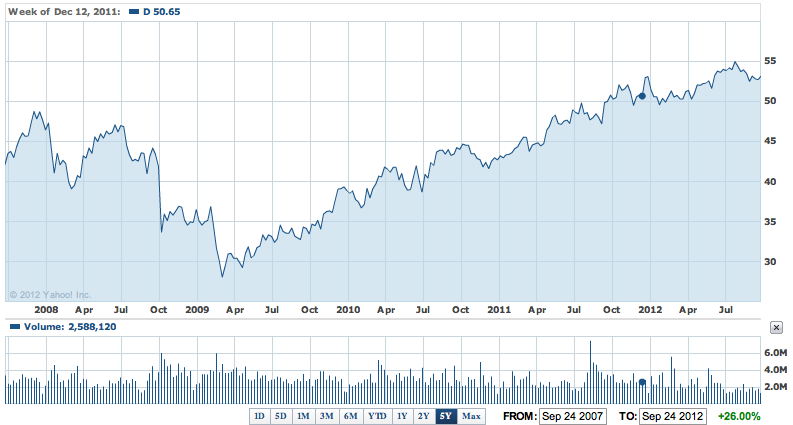
D - Dominion Resources, Inc. My natural gas supplier finally convinced me that I should buy its stock and get back some of my heating bill money. As the price has gone up, the dividend yield percentage has shrunk a bit; it is now a hair over 2%. Still, winter comes once a year to this corner of the globe, and I see a future for furnace fuel far into the distance. I bought it in late 2008; it was at about $35 then.SJM - I originally bought Smuckers at $42.24 per share, a steep price for me, but since we drink Folgers coffee, eat Jiff peanut butter, and bake with Crisco, it seemed like the right thing to do. While it pays $1.92 annually, it traded over the last year from $60.46 to $80.25, and if it wasn't for the Folgers, I probably would have sold it. I can't justify spending any more money on this one; it is now too risky for me.PFE - Pfizer was not purchased because it produces Viagra. At the time I bought it, it was paying a 32 cent quarterly dividend, or about an 8% return. When the dividend was cut to 16 cents, the price plummeted, but it is now back up to 22 cents, with a current return of about 3.6%.KMB - Kimberly-Clark makes Scott toilet paper. 'Nuf said. What goes in, must come out; there will always be a need for toilet paper. I bought a few shares at $58 and cannot justify buying more at today's prices, but the dividend is hefty enough to register about a 3.5% return.WIN - Windstream is a telcom stock. I was driving around Geauga County, seeing Windstream Cable vans everywhere, and decided to buy. My initial 100 shares were purchased at $14.21, and over the last year it has traded in the range of $10.76 to $14.40. The dividend, however, is $1.00 annually, or 7% on my initial investment, and being in a DRIP, it has grown to the point where if I had to sell it, I would likely break even on my initial principal. If I hold it and let it grow, it will, in a decade or so, be a handsome income stock. As of September 24, the dividend return is just over 9%.FE - FirstEnergy is an electrifying stock. Yuk-yuk-yuk! Hey, same idea as Dominion, here. I have to light my bulbs, I may as well pay myself for the favor. Paying about 5% now.CAG - Conagra Foods makes ACT II popcorn, Hebrew National hot dogs, and Swiss Miss cocoa. Gotta have it. Returning roughly 3.5%.LYTS - I purchased 100 shares of LSI Industries at $7.26; it pays 20 cents annually for a 2.75% return on my initial investment, and roughly 3.5% at current prices. However, it is in a Dividend Reinvestment Program, and over the last year has traded in the range of $5.85 to $9.61. It is a park-and-forget stock. I bought it because I was intrigued with the electronic billboards that LSI makes. Besides, it's an Ohio company. Have to keep the neighborhood employed.RPM - Rustoleum Products, anyone? Another neighborhood business, paying about 3%.GRC - Gorman-Rupp Company. Hmmm. I bought this to show solidarity with my son-in-law. Have to keep him employed. Good thing this stock did a 5 for 4 split soon after I bought it. Still under water, and only paying about 1.4%. HOWEVER. It has some strong points, like almost zero debt, and a huge market for its industrial pumps. Tortoises belong in every portfolio. It was purchased for the long-term, though, and is (to me) a prime example of the idea of exercising the Genesis 1 requirement.FTR - Frontier Communications is another communications holding, bought initially at $5.95 and paying 75 cents annually, or 12.6%. It has had a 52 week range of $5.33 to $9.84 and is being held for income. Although the quarterly dividend was cut to 10 cents, it is still putting out over 8.5%.ALSK - Alaska Communications. What? Yep, a cheap dividend stock. Looks like a loser, but when something is this cheap and paying 8% - 9%, you buy lots and hang on. Besides, they nearly have the wireless spectrum cornered in Seward's Folly. I can live with this risk.DOW - The Dow Chemical Company. Better living through chemistry. I'll buy that. I did. Paying about 4%.OLN - Every feller needs his Winchester. Buying this was an American thing to do. Besides, it pays about 3.5%.TNK - Teekay Tankers is a company for us oil speculator types. Of course, all we do is fill up the big tubs and sail them from place to place. As long as the return is in the 10% - 13% range as it has been this year, I'll anchor some money here. This is one where the dividends have outweighed the loss in principal over the course of the year.NM - Navios Maritime Holdings is a Greek owned bulk carrier with a huge modern South American terminal. Somebody has to feed the world; we deliver the food. And other stuff. They were a cheap buy, and the dividend is about 6%.CSX - Well, I couldn't afford the Reading or the B&O, so I bought CSX since it was cheap and had a cute internet commercial. It is paying about 2.6%. The graph for this one shows why being a day trader is a sure cause of heart attacks. In this rodeo, you get on and hang on. We will always need our choo-choos, and I will probably buy more of this in the future.I see only one legitimate and constructive way of "occupying" Wall Street. Buy stocks.



Wednesday, January 18, 2012
How I Became a Dirty Capitalist
Life is evolutionary in the broadest sense of that term. Constant change occurs, both qualitatively and quantitatively, and that change is directed by God. (I do not believe in randomness as a pure function of existence, for while randomness is a useful mathematical concept and tool, much on the order of imaginary numbers, it is simply a subset of a more complex, highly directed universe. Entropy is not a proof of randomness, but an evidence of direction in existence.) God set up His creation at the highest level of organization, set mankind within it to maintain it to the best of their ability, and gave to people sets of goals and limits to maximize their success in Project Earth.
God also intervenes in the affairs of men, a function which was often described by people of an earlier time as "Providence", but which needs to be understood as something like a number line, where values can be perceived as either positive or negative, depending on a person's relationship to the zero point. Those who lack a proper relationship with God may find fault with "negative Providence", but in every instance, that which is "negative Providence" for one person will in some way be "positive Providence" for someone else. The truism is that, for those who love and respect God, everything is working to achieve God's intended goal.
I admit I am a neophyte in the world of capital investments. It was not until I was 44 years old that I began to invest in stocks, and that happened in an evolutionary sort of way.
I was always impressed by my father's ability to make do with a relatively meager income. He came of age at the start of the Great Depression. Graduating from high school at the beginning of FDR's regime, he felt extremely fortunate to have a job where his talents were totally unappreciated. Although he took college preparatory courses in high school, he had no money for college tuition; he would spend his life as a laborer. I remember him counting his pennies at the end of each day, journalling his expenses.
Dad kept track of every cent, and was not about to risk what he had in a stock market that he had been led to believe was not worthy of trust. Conventional wisdom of his time held that stock market investment was merely a form of gambling. His tales of the Depression and his own experience with stocks colored my perception of such investments.
There was little effort put forward during my schooling to explain that ownership of stock was ownership of the industries that employed people. Those were the days when public schooling was keyed to turning out workers rather than owners. Not much has changed since then, I suppose. As a teenager in the 1960's, my teachers were liberal in their persuasion and my life philosophy was a crazy amalgam wherein I viewed "big business" -- my perception of capitalism -- as somewhat "dirty". Further, my religious orientation at the time was such that it seemed wrong to be laying up treasures on earth. (Laughably, communism -- the doctrine of community ownership of capital -- was railed against but its tenets could not legally be taught in public schools. Had it been properly taught and contrasted with private ownership of capital, the socialistic leanings of the political power-mongers would have been exposed for what they were.)
In the mid-1950's the company Dad worked for instituted a profit-sharing plan in which the customary annual bonuses would be invested in the company's stock. Dad went along with it simply because he had no choice. In 1962, faced with the physical necessity of getting out of the meat coolers or dying, he accepted a job, at minimum wage, with Myers Tire Supply. Due to his financial necessity -- a new house, new car, five kids -- he persuaded his old company to give him the principal amount he had invested (via unpaid annual bonuses) in their profit-sharing plan.
His old employer grudgingly gave him the money, but only to the limit of the principal amount of the bonuses he was entitled to. A few months later that company filed for bankruptcy protection; to Dad's knowledge, he was the only employee that saw anything out of the profit-sharing plan. Thus he was extremely skeptical when Uncle Bill urged him to participate in Myers' profit-sharing plan, but he agreed to try it. Unknown to us was the future, in which dividends from Dad's steady investment in Myers stock, with its occasional splits, would form a small but welcome addition to Mom's income beyond Social Security.
My true education in economics began in the late '80's, as I struggled to maintain a business with employees. I had never before been faced with the problem of cash flow in a situation where the livelihoods of others was at risk. Not only was my position with regard to the role of capital fiscally disastrous, it also became apparent that it was at odds with the more important tenets of my faith. You simply cannot share or give to others that which you do not have.
In 1991, hearing stories of money to be made, I succumbed to temptation and invested $1000 in BCCI -- the Cayman Island Bank. Dad and Mom had taken out a $500 life insurance policy (through Prudential) for me when I was a newborn; over the years the policy amount had swelled to over $3000 and I was able to scrape up the cash by borrowing against the policy. Shortly after the investment was made, the assets of BCCI were seized. By the grace of God -- Providence -- a limited amount of principal was recovered. To put it in a safe place, my brother-in-law, Mark Novkov, reinvested it for me in a mutual fund, the Investment Company of America (ICA).
I knew nothing about mutual funds, their investment strategies, or their management. ICA, however, was a company with a long track record, and I was pleased with the dividends that began to be reinvested every quarter. Investing in the stock market was something I was now willing to try, but I was uncertain how to find a broker. Besides, we were financially strapped, paying back money that had been borrowed to pay ruinous Federal employment taxes, medical bills, and to keep my business afloat. Most years, I had no spare cash to even make more than token repayments on the principal amount of the policy loan; for some years I was able only to make the small required annual interest payment.
Then, in 2001, Prudential de-mutualized and issued stock to each of its policyholders. I was issued 24 shares. I cheerfully accepted my annual dividend check, which offset the annual interest on the policy loan. In 2003, I was hired as staff appraiser by Charter One Bank, and for the first time in years my income allowed me to make substantial progress in eliminating my debt. Also, the company matched employee investment in its profit-sharing plan, and I took advantage of the opportunity to get some free money.
When Charter One was bought out by Royal Bank of Scotland in 2004 and all the appraisers were let go, the amounts I had vested in the profit-sharing plan were rolled into IRA mutual fund accounts, but ICA was not an available choice through the IRA manager. I was introduced to several other mutual funds, and learned that IRA accounts were not free. IRA account managers collect a percentage each year from the accounts. This is not a problem when the funds in the IRA are growing and producing income, but if the funds show a loss, the IRA account will be charged for the manager's fund. That worried me, since, as an appraiser with a grasp of how mortgage financing was supported in the marketplace, I was well aware that the economy was overheated and ready for a downturn.
Additionally, all of the dismissed former Charter One employees had been given stock options as part of the buyout package. The company that would manage my RBS stock options was Computershare, which was also the agency used by Prudential for stock management. I logged into Computershare's website, set up my account, and discovered that I could buy and sell stock through them. They would act as agent, holding the shares in my name, and would reinvest any dividends according to my instructions. The stage was set for my entry into the World of Wall Street.
While part of the Charter One severance package was full vesting in all profit sharing, another part was the granting of options on Royal Bank of Scotland stock. The package gave me an option on 150 shares at £15.53, to be exercised between September 1, 2007 and March 31, 2008. In early 2007, as the advance ripples of the global banking meltdown began to trouble the banks, the Plan was altered with a 2-for-1 bonus issue; I was then holding an option on 450 shares at £5.1766 per share.
Needless to say, I became extremely interested in the price of RBS stock in 2007, and realized that due to the European bank meltdown (which I had been expecting for some time, although I was frustrated that no one else seemed to see it) exercise of the options would be touch-and-go. In February 2007 RBS hit its high of nearly £6. On March 21 it was beginning to slide, at £5.80. On September 14, 2007, the stock was at £4.56; if I wanted to exercise the option, I would have to pony up £277.47, or about $550 at current exchange rates. By March 20, 2008 RBS was at £2.75 and my options would have cost about $2,100 to exercise. I was not impressed, and in what I now consider to have been one of my finest hours, I let the options expire. Today RBS is trading at about £0.25. Good riddance.
There was an upside to that experience. While doing all that sleuthing in the markets, I also discovered that Dominion Energy, our natural gas supplier, had a program whereby its customers could purchase Dominion stock directly through them, and Dominion would reinvest the dividends (or send a check, whichever you might prefer) at no cost to the shareholder. I began to look for ways to come up with cash to open an account through Dominion Direct. My rationale was that as a Dominion customer I might as well get some of my heating bill money back as dividends.
A second discovery was that Computershare, as agent for a number of companies, offered a long list of stocks which could be purchased directly, and many of the companies which used Computershare would also pay any brokerage fees for the reinvestment of dividends. Throughout 2008 I studied a number of stocks available through Computershare, looking for companies which paid good dividends and which also paid the reinvestment fees. In late 2008 I took the plunge, buying 100 shares through Dominion Direct, and investing $1,000 in J. M. Smucker (we drink Folger's coffee and eat Jiff peanut butter) and $500 in Pfizer (seemed to be a low priced stock with a good dividend) via Computershare.
Throughout 2009 and 2010, the interest rate on our passbook savings account steadily declined. I began to look for an alternative bank. ING was recommended. In August 2010 several events occurred which would trigger a bank switch.
The funds in my IRA account had been a choice made when I had no known options for a different type of investment, and they were weak performers. They were also subject to annual management fee charges, as I mentioned above. Those accounts had lost heavily in the 2007-2008 downturn, but in mid-2010 they perked up and regained to the point that they were worth, in August 2010, what they had been worth two years earlier. I decided to sell and reinvest in stocks that had a track record for good dividend performance.
ING offers its depositors a brokerage account called Sharebuilder. Sharebuilder differs from Computershare in that Computershare is an agent which holds the stock in the name of the purchaser whereas the Sharebuilder account is a brokerage account which holds the stock for the depositor. Also, Computershare executes trades on set days of the month, whereas the Sharebuilder depositor is able to make trades in real-time and has more choices as to available stocks. If the investor chooses, shares purchased in real-time (at opportune prices) can be transferred from Sharebuilder to Computershare. There are valid reasons for holding the shares in either account, depending on the type of strategy the investor wants to use for growth or trading.
I deposited the funds from the sale of the IRAs into an ING Orange account which I then linked to a Sharebuilder account. Instead of the 0.84% that FirstMerit was currently paying, ING Orange was paying 1.10%. Further, the first purchase I made through Sharebuilder was for 100 shares of First Energy, which currently has a rate of return of about 5.2%. ($2.20 annual dividend on today's [1/18/2012] close of $41.97 per share.)
It isn't all gravy. There are dangers in investing in stocks. There are no guarantees that a company will stay in business or even make a profit. The day I bought my 100 shares of First Energy (at $39.33), the stock price tumbled almost 10% immediately after my purchase and only very slowly recovered over a period of several months. Had I made the purchase for speculative purposes, it would have had to be viewed as a huge loss, but because I am looking for long-term growth and income, I am confident that the investment is sound.
Owning part of a company brings to the shareholder the same kinds of concerns a sole proprietor faces on a daily basis, but usually without the urgency. It can also bring the satisfaction and reward that comes with successful business performance. I have learned a lot in a short time, and have formulated some concepts that I would like to pass on. Remember though-- there are no guarantees in stock ownership, and I, myself, am still learning on a daily basis.
Saturday, January 07, 2012
Alas, Babylon!
When the book with the above title was published just over 50 years ago the Cold War raged; the United States was the champion of freedom and Godless Russian Communist atheism was seen as the enemy of that freedom. The worm has turned. To everything there is a time and a season. Last night was Christmas Eve in Russia : the readers of ITAR-TASS 50 years ago would have stopped their breath in wonder.--------------- Medvedev congratulates Russian believers on Christmas Photo ITAR-TASS
MOSCOW, January 7 (Itar-Tass) — President Dmitry Medvedev has congratulated Orthodox believers and all Russian citizens marking Christmas.
“The Christmas days give us eternal light of belief and fill us with joy and hope. This is the time of good thoughts and good deeds, care about family and unknown people who need our helping hand,” he said in his congratulatory message.
“Sharing with you the joy of this holiday I wish you health, happiness and all the best. Let the light from the Star of Bethlehem bring happiness, love and harmony to every family and prosperity to our country,” Medvedev said in his message.
© ITAR-TASS. All rights reserved.
You undertake not to copy, store in any medium (including in any other websites), distribute, transmit, re-transmit, broadcast, modify or show in public any part of the ITAR-TASS website without the prior written permission of ITAR-TASS.---------------
We need only contrast this with the attention paid to Christmas in Washington this past December -- a tree with an Obama Ornament on it.
“12 How art thou fallen from heaven, O Lucifer, son of the morning? and cut down to the ground, which didst cast lots upon the nations?
13 Yet thou saidest in thine heart, I will ascend into heaven, and exalt my throne above beside the stars of God: I will sit also upon the mount of the Congregation in the sides of the North.
14 I will ascend above ye height of the clouds, and I will be like the most high.
15 But thou shalt be brought down to the grave, to the sides of the pit.
16 They that see thee, shall look upon thee and consider thee, saying, Is this the man that made the earth to tremble, and that did shake the kingdoms?
17 He made the world as a wilderness, and destroyed the cities thereof, and opened not the house of his prisoners.
18 All the Kings of the nations, even they all sleep in glory, everyone in his own house.
19 But thou art cast out of thy grave like an abominable branch: like the raiment of those that are slain, and thrust through with a sword, which go down to the stones of the pit, as a carcass trodden under feet.
20 Thou shalt not be joined with them in the grave, because thou hast destroyed thine own land, and slain thy people: the seed of the wicked shall not be renowned forever.
21 Prepare a slaughter for his children, for the iniquity of their fathers: let them not rise up nor possess the land, nor fill the face of the world with enemies.
22 For I will rise up against them (saith the Lord of hosts) and will cut off from Babel the name and the remnant and the son, and the nephew, saith the Lord:
23 And I will make it a possession to ye hedgehog, and pools of water, and I will sweep it with the besom of destruction, saith the Lord of hosts.” Isaiah 14:12-22(Geneva 1560)

Monday, December 26, 2011
On Hornets and Hackers...
It was when I was a newly feathered teenager that we one day discovered in the pine trees on our extra side lot a big hornet nest. Being exceptionally bright cookies, my brothers and I decided that it would be bad medicine to disturb that paper metropolis from up close. Being exceptionally mischievous malingerers, we also craved the excitement of demolition. Besides, everyone knows hornets are evil; harassing them would be a good deed. The solution -- we stood back about 50 feet away and shot into the nest with our BB guns.
Did you know that hornets can detect the direction and angle of fire of projectiles at significant distances from their source? We learned something new that day; a victim will only be a victim until he discovers a way to turn the tables on his tormentor.
On Christmas Eve the Internet terrorist organization known as "Anonymous" reportedly broke into the database of Stratfor Global Intelligence, a company that does news analysis for a world-wide client base. The terrorists stole subscriber usernames and passwords, gained access to their credit card accounts, and ran up charges by donating money to charitable organizations.
Reading the comments generated on a number of websites and blogs, it is obvious that there are large numbers of people who are morally degenerate enough to think that Robin Hood tactics are a means of doing good. That should have been obvious from the support that the Occupy Movement has had, even from people who otherwise have a reputation as good citizens. The fact that even political leaders seem to feel that evil deeds will solve the Nation's problems ought to serve as warning that we are headed for catastrophic anarchy, and the eventual loss of cherished freedoms.
I have a number of friends, many now retired, who have worked in the IT field since the 1960's (some even longer) who contemptuously call such troublemakers "script kiddies". They spent a good part of their careers working to foil people who either as a game, or as part of organized espionage, attempted to circumvent security features and access data which was not intended for public exposure. They are well aware that most security breeches are caused by laxity on the part of an IT department which has not considered itself a target for one reason or another. They are also quite confident that as such exploits grow in number, there will be retaliatory measures taken.
"Anonymous", "Occupy Whatever", and other such self-absorbed dreamers need to understand that their mischief to this point has been directed at groups and organizations which have not attempted retaliation. The clients of Stratfor, however, are a mixed bag of corporate and governmental entities, and includes private contractors for security concerns. One of the reasons for attacking that site was that Stratfor was somehow considered "evil", merely on the basis of who they accepted as clientele. One of the reasons for shooting BBs at the hornets' nest was that they could possibly sting people.
In all the wide world there probably are well trained and genuinely evil people who patronize think tanks like Stratfor. That should give the terrorists pause. Just as they are able to use their technological skill to break in, steal information, and use it to create havoc, their victims are also technologically capable, and will eventually be able to track down their tormentors.
At that point, the Internet terrorists had better hope that their victims are much less evil than they originally believed. Back in the bad old days, if you attacked a robber baron and stole his money or embarrassed him, he might not only come after you to kill you, but he might also strike at those near and dear to you. It is said that "Anonymous" tried to shake down a Mexican drug gang, and was warned that the consequences would be dire. They should not sleep too comfortably in the misapprehension that their victims on Wall Street and in other high places around the world are less serious about revenge than the drug lords who have no compunction about hanging their tormentors on wires from bridges, or removing body parts to send a message. Hornets do not like to have their nests disturbed.
Friday, May 13, 2011
Poking a Hornet's Nest
The news yesterday morning carried the story that John Demjanjuk, the man known to many as the guard "Ivan the Terrible" at the Sobibor death camp for 6 months in the summer of 1943, was found guilty of the murder of over 28,000 people there.
If you recall, Demjanjuk moved to Cleveland after WW2 and became a U.S. citizen. When he was finally tracked down, he was stripped of his citizenship and deported to Israel to stand trial. The FBI stated that the evidence of his crimes came from the Soviet KGB and could not be trusted. He had lied about his past on the citizenship application, however, and the decision of the INS was just.
In Israel, at his trial, there were no witnesses who could say that Demjanjuk had actively participated in any murders. A cruel guard, yes. A murderer, no. He was convicted and sentenced to death, but the conviction was overturned on appeal when evidence pointed to a different guard.
Charges were then quickly filed in a German court. The German court has now found Demjanjuk guilty of murder -- not because he had actually killed anyone, but because he was present as a guard in the camp at the time murders were committed. His was guilt by association.
Perhaps the lesson is that people should always act according to their conscience and not follow the crowd. The Nuremberg tribunals should have had a bigger impact on our society than they did; the principle that a person is responsible for his own actions regardless of the authority issuing orders became a basic tenet of American law. That was why the courtmartial of LTC Terry Lakin, for refusing to go to Afghanistan until he was shown valid proof that President Obama was indeed Constitutionally eligible to occupy the office and act as Commander-in-Chief, was so critically important.
That same President acted on information as to the whereabouts of a man who was wanted in the United States for the murders at the World Trade Center. He ordered the SEAL team to enter Osama bin Laden's compound, and, if bin Laden resisted capture, to kill him. The SEALs were simply following their orders. An accused (and self-confessed) murderer was put to death, and it seemed that all America rejoiced.
The Constitution of the United States was a unique document, designed to protect the individual from the overly exuberant exercise of democracy. It protected the individual from searches without a warrant (4th Amendment). It protected the individual from trial for a capital crime without indictment by a grand jury, and from being forced to testify against himself (5th Amendment). It provided that an accused criminal had the right to be tried before a jury and to confront the witnesses against him (Article 3 Section 2, and 6th Amendment).
America has rejoiced over the elimination of Osama bin Laden. In other parts of the world, however, questions are being asked as to whether or not his execution was carried out legally. Congress did not declare war on bin Laden, nor on Afghanistan, nor Pakistan. No grand jury indicted him for murder. The Prime Minister of Germany stated that she was glad bin Laden was dead; a German judge has filed criminal charges against her for violating a German law forbidding the encouragement of illegal acts. Could it be that the German judge has a better grasp of American law than our own President? Could it be that in following their Commander-in-Chief's orders -- and the democratic will of the majority of Americans -- the SEAL team violated their oaths to support and defend the Constitution?
Additionally, while the Constitution made the President Commander-in-Chief of the armed forces, Congress alone was given the power to declare war, raise an army, and call up the militia. It was also left to Congress alone to appropriate money and designate what it would be spent on.
A second headline in yesterday's news had to do with the NATO bombing of Muammar Gaddafi's compound in Tripoli, killing two journalists and their guide. Secretary of Defense Gates has said that the bombing of Libya serves no important United States interest, but that it has cost us $750,000,000. Congress has still not approved the bombing and the expenditure of the money. The American pilots flying for NATO are just following the orders of their Commander-in-Chief.
While the bombing was instigated by our NATO allies and some of the Arab League, much of the rest of the world, including the Russians and the Chinese, have been expressing their disapproval. Congress has not declared war on Libya, and no American grand jury has indicted Gaddafi of a capital crime. Could it be that the Russians have a better grasp of American law than our own President? Could it be that in following their Commander-in-Chief's orders, the American pilots have violated their oaths to support and defend the Constitution?
In the summer of 1943, John Demjanjuk never thought that his service as a guard, just following orders, would someday earn him a murder conviction. He didn't actually kill anyone. His big crime was that he was there and didn't object. Can America learn a lesson from that example? Will we someday, as a nation, stand before the Judge of the Whole Earth and answer for the fact that we were given a Constitution which we trampled under foot for the sake of revenge and self-righteousness?
Saturday, March 05, 2011
Hands Off Libya!
In the 2000 Presidential election, I voted for George W. Bush. At the top of the list of reasons was his statement in the campaign that his hero was Jesus Christ. Such a statement, in the political climate of the time, was a bold and brave position -- it bespoke personal courage. A second reason was his avowed fiscal proposals which closely approximated my own, such as allowing private citizens to partially control their Social Security accounts, in short, granting them true ownership of their retirement funds rather than having the government hold those funds in trust. A third reason was his position on the role of the United States as a "nation-builder" -- he stated in his campaign that such activity had to come to a stop.
That last reason was one which I greatly cheered. I have always respected George Washington's view that the United States should avoid foreign entanglements. The Federal government was intended to provide a mechanism for the sovereign States to"insure domestic Tranquility, provide for the[ir] common defense, promote the general Welfare, and secure the Blessings of Liberty to ourselves and our Posterity".It was not intended as a proxy for them to wage war on other governments. I had hoped that Mr. Bush would pursue a course away from the use of American military might in an offensive capacity, particularly those actions which advanced the political will of other foreign powers. The toadying of Mr. Clinton to the European Union in countering the efforts made by an American ally in the fight against Islamic terrorism had been particularly disappointing.
The post-9/11 response of the United States was, to me, a missed opportunity. Rather than turning our gaze upon ourselves and seeking the guidance of God to react in a manner that would starkly contrast the position of a nation based on Christian principles as opposed to terrorists with Islamic principles, we sank to their level. Rather than turning to God Almighty as our protector and avenger, we, as a nation, directly disobeyed His command to not seek revenge on our own.
True, we wreaked revenge on the Taliban in Afghanistan for their support of terrorists. Nevertheless, the Taliban were not destroyed, and when American policy shifted, from winning the hearts of the people by helping them, to the surge of combat forced by those who had fixated on destroying bin Laden, we undid all the good which we had previously boasted. We are in a no-win situation in that country, desperately seeking a way out.
True, we removed Saddam Hussein from power, but into the vacuum moved more Islamic radicals, particularly those allied with the Iranian regime. Our troops are moving out of Iraq, and the "democracy" that we supposedly instituted there will quickly increase the power of the Shiite mullahs as soon as our troops are gone. However, as with all democracies, the rights and freedoms of individual Iraqis will be curtailed in favor of the will of the heathen mob.
Currently, there is pressure on the United States to "do something" militarily to intervene on behalf of the anti-government forces in Libya. The reasons given are that a number of U.S. nationals are unable to get out of that country and may be endangered by the fighting, and, besides, the oil must be kept flowing. There is also pressure on the United States to "do something" about the pirates operating out of bases in Somalia. The instant another "hot spot" develops, pressure will rise for the United States to "do something" militarily to resolve the problem. Of course, the moment any such "something" is done, our nation will be vigorously condemned by the most vocal of our enemies, and weakened by having disobeyed God.
The United States was not "built" by some other nation intervening in the affairs of the States. Our Constitution was not forced upon us by a cabal of other nations that wanted to see us free. Our liberties have been dribbled away by decades of voters apathetic to the basic problems we face, but they were gained through the mortal sacrifice of thousands of citizens who wanted to "secure the Blessings of Liberty to ourselves and our Posterity". Until the peoples of other lands have that same drive and zeal, no amount of American military might can make and keep them free. We are stupid to waste our resources chasing dreams induced by the drug called pride.
What should our response be to the violence in Libya? I would say, stay out of it. U.S. military intervention will not win us any lasting friends, and in the end will not serve any national security purpose since a "democratically" elected government there will have the same attitude toward us as that of the Afghans and Iraqis. Besides, anyone caught up in the chaos in Libya was probably there mainly to assist those who oppose American policy; there were few other reasons for American nationals to be in a country which was antagonistic toward us. Let the Libyans sort it out themselves. It is the only way they will gain any lasting appreciation for their freedom once they grasp it. If American nationals want to privately take sides in the fighting over there [shades of the Spanish Civil War?], let them, but do not spend any effort to extract them when the going gets tough. Also, any attempts to prosecute that warfare on American soil should be dealt with as an ordinary crime; "freedom fighters" carrying the war to America are simply terrorists of a different stripe.
What of the Somali pirates? Our navy was created to protect American shipping, but it has no business doing the dirty work for other nations. The Constitution has the solution embedded in Article 1, Section 7 :"To declare War, grant Letters of Marque and Reprisal, and make Rules concerning Captures on Land and Water".All Congress has to do is resolve that the pirates are a menace, and then start issuing hunting licenses. The sinking or recapture of the vessels used by the pirates as "mother ships" would soon make the pirates more cautious as to who they might attack, and the ability to sell the prizes would attract both investors and privateer sailors.
Our military personnel are too valuable to be used as a sop to foreign powers that want us to solve their problems for them. Under strict interpretation of the Constitution, they were intended only for defense. To the Founders, the concept of a standing army was distasteful (note the 2-year limitation on military appropriations in Article 1, Section 7); the army of King George had been a primary aggravation to the signers of the Declaration. The Constitution was a compact between the States, and the chief reliance was to be upon the Militia (again note Section 7) --"To provide for calling forth the Militia to execute the Laws of the Union, suppress Insurrections and repel Invasions".That would imply use only within the borders of our own country. The need to impose command structure on the varied elements pushed the Congress to further institutionalize the military, and with that extension of control by Congress, the tasking of our military became a political problem.
It is high time to carefully disengage our troops from overseas combat and retask them to true national defense. It is high time to cease meddling in the internal power struggles of other nations and allow them to gain their own liberty with self-respect. We have no business building other nations.n.b. There are those who immediately raise the Posse Comitatus Act and the Insurrection Act as objections, but those laws permit use of the military for law enforcement if so authorized by Congress. The defense of our own borders does not require any change in our current laws, rather, it simply requires the will of Congress to do something. While the President serves as Commander-in-Chief of the armed forces, his dereliction of duty in the face of a Congressional declaration would be an act of treason. In any event, upon the President's failure to act, or the failure of Congress to act, the command of the Militia (as contrasted to the National Guard, which is part of the Army) devolves to the governor in most States.
Saturday, January 29, 2011
Ricin Beans
The big news out of Summit County the past day or so is the FBI bust of a man in Coventry Township who was arrested "on a federal charge of illegal possession of a biological substance" (Owner of house arrested on ricin charge). The ABJ story also contains a quote from the Coventry fire chief, saying "'a very small container in the refrigerator, less than a coffee can", and a reassuring one [sarcasm is my middle name]:Gene Nixon, Summit County health commissioner, said the substance "seemed to have been there a long time" and endangered no one.At this point, the former resident (his house is in foreclosure) who is unemployed, on Medicaid, has no assets, and had to borrow a pair of glasses to read the complaint, has a warm place to sleep and plenty to eat in a publicly run hostel [AKA jail].
"Relax . . . there's never been a threat," he said.
The article also states that the man being arraigned had not yet been interviewed by the FBI. It fails to mention the form or quantity of the "ricin". What we are told is that the FBI received a "tip" that ricin was present in the house, and acted to seize it. We are also told,"Scott Wilson, an FBI spokesman, would not speculate on the motive for possessing the material but ruled out terrorism as a possible use."I once had a high regard for the FBI -- until I had need of them. In all my life I have only notified authorities once of a crime -- it was so egregious that to ignore it would be to participate, seeing that I had been engaged by one of the participants as a ploy in covering it up and facilitating it.
Several years ago I was engaged to appraise a property for a sale. The home had not been completed, and a prior appraisal had failed to take into account the value "as-is" as well as "as-complete". The loan officer readily faxed me a copy of the sales agreement, which showed a price nearly $500,000 over the list price. It also did not have the seller's signature. I requested a copy of the agreement from the real estate agent, and what she faxed me had a sales price very near the list price. The original appraisal utilized comparable sales that were completely outside the subject's market, and fully supported the price on the loan officer's bogus sales agreement. I checked on the buyer -- the internet is a valuable tool for locating people -- and found that he had a strong Middle Eastern presence. Further, the property under consideration was one which I would consider ideal for certain types of para-military training operations.
So I called my local FBI office. And left a message. And called them again. It took nearly two weeks before an agent called me back to ask more about the particulars. I told him what I had discovered; that I had black-and-white evidence of bank fraud to the tune of a half million dollars.
His advice? The sum in question was too small for the FBI to be concerned about. I should call my local Sheriff and have his fraud squad take care of it. Do I respect the power of the FBI -- their arms and technology? You betcha. Do I think they are interested at all in upholding the Constitution? You gotta be jerking my chain.
After another week of phone persuasion the Summit County Sheriff sent over a deputy with a subpoena for my file. I specified what the subpoena should request, because I did not want anyone seizing my hard drive containing my appraisal software. The deputy left with the CD containing a complete copy of my findings, my appraisal report, and the original appraisal report. I cannot turn in the fraudulent appraisal to the state regulators because the subpoena forbids me to discuss the specifics of the case with anyone, and that is as far as I take this item.
I will tell you what I think happened to the man in Coventry Township. Ricin is the active ingredient in the pulp of the castor bean. After the bean is pressed for oil, the pulp can be processed and the ricin separated through the use of electrophoresis. I doubt that this man had the technological ability to create his own electrophoresis setup, and from the sound of it, had no money to purchase commercially available equipment. Even if he had, the ability to isolate the ricin from the electrophoresis gel is a further technological step. It is highly unlikely that the substance found in the refrigerator was actually ricin in a form that could be weaponized. If it was weapons-grade ricin, the quantity needed to be effective is so large that our own military has ruled out the practicality of weaponizing it. That is why the authorities could state with confidence that there was no danger and that terrorism could be ruled out.
My guess is that the man had some castor beans in his refrigerator, holding them there to be planted in the Spring. The castor bean plant is a very common ornamental. This fits with the "very small container" description, and the vagueness in describing what was actually found. His misfortune was probably telling somebody that the beans were there and then, perhaps in a fit of Darwinian genius, informing them that such beans were what ricin was made from. Snowballs roll downhill.
This case will probably quietly go away. Lots of tax dollars will be spent in make-work for law enforcement. Osama is probably ROTFL in his cave. The terrorists have scored again, because the US government showed up to help.


