One of the unique aspects of America has been her historic position, based in the Torah, of "Equal justice under the law." (viz. Ex. 23:2-3,6; Lev. 19:15, 24:22; Dt, 16:18-20). There are those of us who have bound ourselves to uphold our Constitution, defending it against all enemies, foreign and domestic. Here is an example of some folks taking that seriously, and making a stand against some domestic enemies of the Constitution :
The Police Loophole I wonder if the makers of defensive tools, like body armor, will have similar dedication to the rule of law.
Saturday, February 23, 2013
Striking back at The Empire
Sunday, December 23, 2012
Yo-Yo With Short String
Some time ago I posted about the need to moderate comments. Here is a prime example of what has to be filtered out. It was submitted to my post on the Speedex S-19 (which, by the way, I still intend to restore):"Thank you for the auspicious writeup. It in reality used to be a leisure account it. Glance complicated to far delivered agreeable from you! However, how could we keep in touch? Look into my weblog :: Forex Trading Demo"(I removed the link)I suspect someone composed that and then ran it through a web-based (maybe Google?) translator. It was definitely not from a native English speaker. It is the second such attempt to attach a comment to that post.Oh, well; I cast thee into the Bottomless Bit Bucket, O vile spammy entrapper.
Who's Peeking? Just fooling around with the Google-y tools for bloggers and looked at the Stats page :
That is a screenshot of where the viewers are from. Hong Kong I can understand. Iran and the UAE? Wonder what it was that I said that aroused their interest. Is Paranoia an island in the South Pacific? Inconceivable! (and I'm not Sicilian).
Friday, November 23, 2012
Almost Funny
I just came across a Slashdot article that mentioned a large increase in the use of coal as power-generation fuel in China. This was attributed to the fact that the price of coal has declined significantly in the past few years due to the rise in "green" technologies in Western countries. Thus, while businesses in the West are spending vast sums to reduce CO2 emissions by going with solar and wind power generation packages, the Chinese are profiting from the surplus of coal to run their factories at a lower cost.I suppose the next logical step for the Climate Change Brigades will be proposing legislation to make coal mining illegal in order to drive up the price and force the Chinese into compliance. It should make for an interesting string-pushing contest.
Wednesday, October 24, 2012
Treason
From the transcript of the third 2012 Presidential Debate :SCHIEFFER: "Let -- let me ask you, Governor because we know President Obama's position on this, what is -- what is your position on the use of drones?"
ROMNEY: "Well I believe we should use any and all means necessary to take out people who pose a threat to us and our friends around the world. And it's widely reported that drones are being used in drone strikes, and I support that and entirely, and feel the president was right to up the usage of that technology, and believe that we should continue to use it, to continue to go after the people that represent a threat to this nation and to our friends. But let me also note that as I said earlier, we're going to have to do more than just going after leaders and -- and killing bad guys, important as that is."
With that statement, Mitt Romney failed to make a commitment to renew hope for liberty in America.
When President George W. Bush instituted the War on Terror in 2001 and Congress passed the USA Patriot Act, the jihadists who flew the planes into the World Trade Center towers achieved their greatest victory. They had, through the use of fear, and by arousing a desire for vengeance, caused the United States to begin to devour itself.
Let me remind the reader that the Amendments to the Constitution of the United States, as they were passed in order of time, overrode any prior portions of the original Articles, including the powers granted to Congress, the President, and the Judiciary. That was the purpose of amending the document. Thus we have the following :
Amendment 4 - Search and Seizure. Ratified 12/15/1791.
The right of the people to be secure in their persons, houses, papers, and effects, against unreasonable searches and seizures, shall not be violated, and no Warrants shall issue, but upon probable cause, supported by Oath or affirmation, and particularly describing the place to be searched, and the persons or things to be seized.Amendment 5 - Trial and Punishment, Compensation for Takings. Ratified 12/15/1791.
No person shall be held to answer for a capital, or otherwise infamous crime, unless on a presentment or indictment of a Grand Jury, except in cases arising in the land or naval forces, or in the Militia, when in actual service in time of War or public danger; nor shall any person be subject for the same offense to be twice put in jeopardy of life or limb; nor shall be compelled in any criminal case to be a witness against himself, nor be deprived of life, liberty, or property, without due process of law; nor shall private property be taken for public use, without just compensation.Amendment 6 - Right to Speedy Trial, Confrontation of Witnesses. Ratified 12/15/1791.
In all criminal prosecutions, the accused shall enjoy the right to a speedy and public trial, by an impartial jury of the State and district wherein the crime shall have been committed, which district shall have been previously ascertained by law, and to be informed of the nature and cause of the accusation; to be confronted with the witnesses against him; to have compulsory process for obtaining witnesses in his favor, and to have the Assistance of Counsel for his defence.The War on Terror, as prosecuted via the USA Patriot Act, violates in numerous places the above three Amendments, and is clearly unConstitutional in that respect. Evidences of warrantless searches and seizures, of indefinite detention without habeas corpus, of arrests based on secret testimony; all these are commonly reported in our daily news, with no resistance to the tyranny by those sworn to uphold the Constitution and defend it against all enemies, foreign or domestic. Those hired to protect have been the most egregious violators.
The Obama Drone Policy, of which Romney said, "I support that and entirely, and feel the president was right to up the usage of that technology, and believe that we should continue to use it, to continue to go after the people that represent a threat to this nation and to our friends." has been used to sentence U.S citizens to death without trial. Further, the desire of the current administration to expand the use of drones worldwide against persons who are United States citizens, is an act of treason against the United States, since it gives aid to an enemy whose desire is to destroy our Constitutional protections.
Frequent mention has been made that this election is mostly about the economy. To the average voter, that is probably true, but what is also true is the undeniable fact that the collapse of our economy is inevitable. It will not matter who has won the Presidency. Whether we go forward into ruin under the policies of Obama, or in spite of the 5-point plan of Romney, whoever sits in that chair will face the responsibility for the failure.
America has, however, endured poverty before. The difference was that before, Americans enjoyed liberty under their Constitution. The poverty of free men has a much different feel than the poverty of slaves under tyranny.
It will not matter who wins this election; neither major candidate is a champion of liberty, and Americans will get the government they deserve. America has thrown away a gift from God, and the consequence will be one more chance to seek repentance on our knees.
Sunday, October 14, 2012
Barack or Mitt?
I'm not at all in favor of continuing the status quo of the U.S. government. For most Americans, the choice comes down to one of two contenders, with the argument made that failure to vote for one of the two is simply a wasted electoral exercise. There are serious considerations tied to the upcoming election, and there are certain facts which need to be examined before leaping off into the ballot booth.I. The economy. The Democrat (Socialist) Party incumbent would have us believe that all will be well if we just continue to borrow money. What is not discussed is the fact that money is a portable substitute for goods and services. If money is printed without any backing other than a promise to pay, and the people who own broken promises stop accepting them, the system propped up by that money must collapse. The challenger has offered some ideas that would slow down the breaking of the promises, but not eliminate them altogether. Further, sober number-crunching shows us that as a nation we have already passed the tipping point for economic collapse. The patient is terminally ill, and we aren't making funeral arrangements yet. When he dies, the body will get stinky in a hurry. Get ready.
2. Personal freedom. The status quo is a movement toward greater restriction and control of individuals and their liberty. The Democrat position is that might makes right; individuals must be subordinate to the will of the majority or face being beaten into subjection. The Republican (Whig) position is that the central government has the privilege of dictating uniform laws across the land; if you are not for them, you are against them, and if you are against them, you face being beaten into subjection. Not much choice of outcomes there.
Helping my mother fill out her absentee ballot the other day -- and no, I did not tell her how to vote, but simply made sure she followed the instructions for filling out the envelope -- I was made aware of the number of choices available on this election's ballot. (From the Summit County BOE website).
- Stewart Alexander/Alex Mendoza (Socialist)
- Susan E. Daniels/Jerry A. Veneskey (Write-In)
- Richard Duncan/Ricky Johnson
- Virgil Goode/Jim Clymer (Constitution)
- Gary Johnson/James P. Gray (Libertarian)
- Nelson Keyton/Jay Jennelle (Write-In)
- Barack Obama/Joe Biden (Democrat)
- Jill Reed/Tom Cary (Write-In)
- Platt Robertson/Scott Fall (Write-In)
- Mitt Romney/Paul Ryan (Republican)
- Jill Stein/Cheri Honkala (Green)
- Randall A. Terry/Cathy Lewis (Write-In)
- Mike Vargo/Jeff Angeletti (Write-In)
Quite an array. We have a fairly clear idea where the Democrat and Republican candidates stand on things, but what of the others? Let's take a look.
Write-Ins & Independents. Those aren't actually write-ins; they are real ballot choices. I have no idea what they stand for. They don't seem well enough organized to actually be effective presiding over the United States.
Socialist Party : "Socialism and democracy are one and indivisible." That is their party line. Socialist Party USA. Prepare to be assimilated. Ugh.
Libertarian Party : "We hold that all individuals have the right to exercise sole dominion over their own lives, and have the right to live in whatever manner they choose, so long as they do not forcibly interfere with the equal right of others to live in whatever manner they choose." That's a nice sentiment, but, personally, I don't subscribe to it, because I know that God will bring us all into judgment. Libertarianism sounds good as long as the fine print is ignored. God ordained government to hold libertarians in check. Libertarian Party 2012 Platform. Sorry, I don't buy this.
Green Party of the United States : "We are partners with the European Federation of Green Parties and the Federation of Green Parties of the Americas." Wonderful. These folks believe government should control everything -- a sort of Anti-Libertarian party -- with the ultimate authority seemingly the UN General Assembly. 2012 Green Party Platform . Run away! Run away!
Democrat Party : "Democrats believe that we're greater together than we are on our own." That's why Mr. Obama can say that an individual cannot succeed without government help. Democratic National Platform. If you are tempted to vote for these guys, read the platform carefully. They spend more time bashing Republicans and bragging about how they spent borrowed money than setting forward their political theory.
Republican Party : "The American Dream is a dream of equal opportunity for all. And the Republican Party is the party of opportunity." Sounds good, and the Prez/VP candidates seem to be men of good character. But … a part of their planned reforms is "…reversing the undermining of federalism…." 2012 Republican Platform . Sounds good, but not quite good enough.
Constitution Party : "The goal of the Constitution Party is to restore American jurisprudence to its Biblical foundations and to limit the federal government to its Constitutional boundaries." Constitution Party National Platform. I guess these folks are as close to what I believe as anybody out there gets.
So what happens if I vote for Virgil Goode and Barack Obama wins the election? Maybe I should be asking what happens if Virgil Goode wins?
You see, the election is not in the hands of the people of the United States. This nation has invited the wrath of Almighty God, not through the actions of its rulers alone, but through the wanton disregard, by the people, of God's standards. It is God who sets up kings and takes them down. It was God who placed Barack Obama in Washington as a warning and punishment for America's sins.
So, unless there is wholesale repentance on the part of the people of the United States, it will not matter who sits in the White House. God will have put that person there. Despite that person's beliefs or desires, God will deal with America according to its sins. If our vaunted freedoms disappear because of our personal, everyday lifestyles, that is God's justice.
Make the best decision you can based on the facts that you have, and leave the results in God's hands. He can save, whether by few or by many.
Tuesday, September 25, 2012
Picking My Poison
There are more kinds of stocks than there are colors in a box of crayons. There are low priced and high priced stocks. There are stocks that can be held for income, and stocks that can be held for growth or speculation. There are stocks that are very risky, and there are stocks that are boringly safe. What kinds of companies will I own?The type of company which a person is interested in buying is a reflection of that person's view of the purpose of investing. It may be helpful once again to visit the story of the beginning. God had created people, and gave to them His first instructions.
- be prolific in order to fill the Earth with people,and,
- exercise absolute control over the Earth to maximize its production for the benefit of the people.
Each person must come to grips with his or her own level of submission to those two tasks. My own response to the the charge leads me to invest in companies which produce goods and services, and most specifically, goods and services of the types which I find myself using in the course of life. Utilities, manufacturing companies, food production, pharmaceuticals, transportation; all these sectors are comfortable in the sense that I feel myself to be providing benefits to other people.
Where a company is located is also a matter of interest. When I invest in a company, I provide it with operating capital which allows it to expand operations and ultimately provide jobs for other people. If I feel a higher level of concern for the people of my own nation than for people in far off places, i will tend to invest in more local companies.
The type of return and the long-range goal of my investing will determine whether I choose stocks which tend to grow in value in and of themselves, or stocks which pay out higher percentages of the company profits in annual dividends. A determining factor in choosing a stock will be its price history over a period of several years. If I wish to speculate -- gamble if you will -- by trying to buy low and sell high, the dividend history of a stock will be of less interest than its price history. If I wish to maximize an income stream from my investment, the ratio of the dividend to my purchase price will be a more important factor.
So, then, some general guidelines which I have formulated for my own holdings:
- The investment must be morally sound. I will not invest in products or services which I feel do not contribute to the betterment of my society. Shares in casinos or cigarette companies are not even on the radar because of their records of destruction of human lives. Neither are insurance or finance companies, since those entities generate their profits through fear and usury. You might be shaking your head at this point, since those kinds of companies frequently offer the highest rates of return. I reserve the right to judge the righteousness of my own investments, and pay the penalty for my judgment.
- The investment must pay a dividend. If I am to be an owner in a company, I want it to make a profit, and when it makes a profit, as an owner, I feel entitled to my part of that profit. Dividends can be tricky; the higher returns often are a sign of higher risk.
- The investment must be affordable and such that downward changes in price are not likely to cause excessive mental stress. I choose cheap(er) stocks for two good reasons. The first is that if two stocks are paying the same amount of dividend annually, but one is half the price of the other, the rate of return for the lower price stock is twice that of the higher. Simple math, but often ignored. The second reason has to do with the volatility of the stock market and the possibility of being forced to liquidate a position in a down market. If the price of a stock declines, say 30%, I will lose far less of my initial investment in X shares of a cheap stock than I would in X shares of a high flyer. I am loathe to spend more than $40/share. While some of my stocks are currently trading in the mid-$70 range or above, I bought them at about $40, and I will not buy any more of those stocks while they remain so expensive (although I will probably let the dividends be reinvested).
So what do I own at this time? What I am about to tell you is not to be considered a reliable guide to making money. You are about to view my idiosyncrasies, and if you attempt to duplicate what I have done, you may loose your shirt (along with the rest of your clothing). Thus, in order of my capitalistic meanderings:
AIVSX - The Investment Company of America. This is my only mutual fund, originally recommended by Mark Novkov. I hold it simply because it has sentimental value. It is also growing, and if you take pleasure in watching trees grow or racing turtles, this one is exciting. It does seem safe, though.
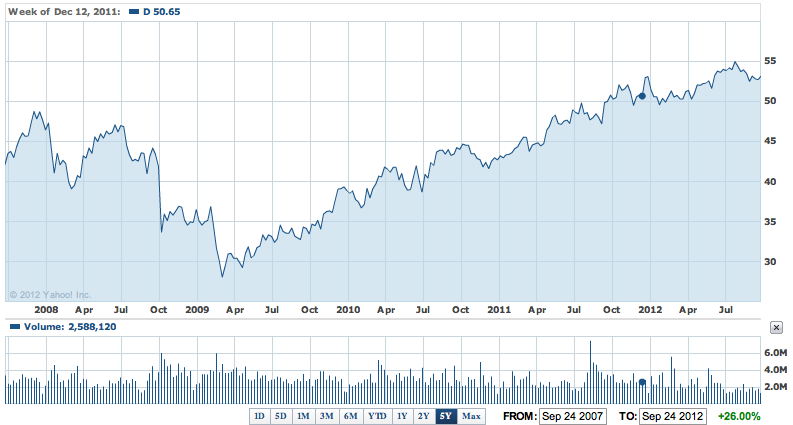
D - Dominion Resources, Inc. My natural gas supplier finally convinced me that I should buy its stock and get back some of my heating bill money. As the price has gone up, the dividend yield percentage has shrunk a bit; it is now a hair over 2%. Still, winter comes once a year to this corner of the globe, and I see a future for furnace fuel far into the distance. I bought it in late 2008; it was at about $35 then. SJM - I originally bought Smuckers at $42.24 per share, a steep price for me, but since we drink Folgers coffee, eat Jiff peanut butter, and bake with Crisco, it seemed like the right thing to do. While it pays $1.92 annually, it traded over the last year from $60.46 to $80.25, and if it wasn't for the Folgers, I probably would have sold it. I can't justify spending any more money on this one; it is now too risky for me. PFE - Pfizer was not purchased because it produces Viagra. At the time I bought it, it was paying a 32 cent quarterly dividend, or about an 8% return. When the dividend was cut to 16 cents, the price plummeted, but it is now back up to 22 cents, with a current return of about 3.6%. KMB - Kimberly-Clark makes Scott toilet paper. 'Nuf said. What goes in, must come out; there will always be a need for toilet paper. I bought a few shares at $58 and cannot justify buying more at today's prices, but the dividend is hefty enough to register about a 3.5% return. WIN - Windstream is a telcom stock. I was driving around Geauga County, seeing Windstream Cable vans everywhere, and decided to buy. My initial 100 shares were purchased at $14.21, and over the last year it has traded in the range of $10.76 to $14.40. The dividend, however, is $1.00 annually, or 7% on my initial investment, and being in a DRIP, it has grown to the point where if I had to sell it, I would likely break even on my initial principal. If I hold it and let it grow, it will, in a decade or so, be a handsome income stock. As of September 24, the dividend return is just over 9%. FE - FirstEnergy is an electrifying stock. Yuk-yuk-yuk! Hey, same idea as Dominion, here. I have to light my bulbs, I may as well pay myself for the favor. Paying about 5% now. CAG - Conagra Foods makes ACT II popcorn, Hebrew National hot dogs, and Swiss Miss cocoa. Gotta have it. Returning roughly 3.5%. LYTS - I purchased 100 shares of LSI Industries at $7.26; it pays 20 cents annually for a 2.75% return on my initial investment, and roughly 3.5% at current prices. However, it is in a Dividend Reinvestment Program, and over the last year has traded in the range of $5.85 to $9.61. It is a park-and-forget stock. I bought it because I was intrigued with the electronic billboards that LSI makes. Besides, it's an Ohio company. Have to keep the neighborhood employed. RPM - Rustoleum Products, anyone? Another neighborhood business, paying about 3%. GRC - Gorman-Rupp Company. Hmmm. I bought this to show solidarity with my son-in-law. Have to keep him employed. Good thing this stock did a 5 for 4 split soon after I bought it. Still under water, and only paying about 1.4%. HOWEVER. It has some strong points, like almost zero debt, and a huge market for its industrial pumps. Tortoises belong in every portfolio. It was purchased for the long-term, though, and is (to me) a prime example of the idea of exercising the Genesis 1 requirement. FTR - Frontier Communications is another communications holding, bought initially at $5.95 and paying 75 cents annually, or 12.6%. It has had a 52 week range of $5.33 to $9.84 and is being held for income. Although the quarterly dividend was cut to 10 cents, it is still putting out over 8.5%. ALSK - Alaska Communications. What? Yep, a cheap dividend stock. Looks like a loser, but when something is this cheap and paying 8% - 9%, you buy lots and hang on. Besides, they nearly have the wireless spectrum cornered in Seward's Folly. I can live with this risk. DOW - The Dow Chemical Company. Better living through chemistry. I'll buy that. I did. Paying about 4%. OLN - Every feller needs his Winchester. Buying this was an American thing to do. Besides, it pays about 3.5%. TNK - Teekay Tankers is a company for us oil speculator types. Of course, all we do is fill up the big tubs and sail them from place to place. As long as the return is in the 10% - 13% range as it has been this year, I'll anchor some money here. This is one where the dividends have outweighed the loss in principal over the course of the year. NM - Navios Maritime Holdings is a Greek owned bulk carrier with a huge modern South American terminal. Somebody has to feed the world; we deliver the food. And other stuff. They were a cheap buy, and the dividend is about 6%. CSX - Well, I couldn't afford the Reading or the B&O, so I bought CSX since it was cheap and had a cute internet commercial. It is paying about 2.6%. The graph for this one shows why being a day trader is a sure cause of heart attacks. In this rodeo, you get on and hang on. We will always need our choo-choos, and I will probably buy more of this in the future. I see only one legitimate and constructive way of "occupying" Wall Street. Buy stocks.
Wednesday, January 18, 2012
How I Became a Dirty Capitalist
Life is evolutionary in the broadest sense of that term. Constant change occurs, both qualitatively and quantitatively, and that change is directed by God. (I do not believe in randomness as a pure function of existence, for while randomness is a useful mathematical concept and tool, much on the order of imaginary numbers, it is simply a subset of a more complex, highly directed universe. Entropy is not a proof of randomness, but an evidence of direction in existence.) God set up His creation at the highest level of organization, set mankind within it to maintain it to the best of their ability, and gave to people sets of goals and limits to maximize their success in Project Earth.
God also intervenes in the affairs of men, a function which was often described by people of an earlier time as "Providence", but which needs to be understood as something like a number line, where values can be perceived as either positive or negative, depending on a person's relationship to the zero point. Those who lack a proper relationship with God may find fault with "negative Providence", but in every instance, that which is "negative Providence" for one person will in some way be "positive Providence" for someone else. The truism is that, for those who love and respect God, everything is working to achieve God's intended goal.
I admit I am a neophyte in the world of capital investments. It was not until I was 44 years old that I began to invest in stocks, and that happened in an evolutionary sort of way.
I was always impressed by my father's ability to make do with a relatively meager income. He came of age at the start of the Great Depression. Graduating from high school at the beginning of FDR's regime, he felt extremely fortunate to have a job where his talents were totally unappreciated. Although he took college preparatory courses in high school, he had no money for college tuition; he would spend his life as a laborer. I remember him counting his pennies at the end of each day, journalling his expenses.
Dad kept track of every cent, and was not about to risk what he had in a stock market that he had been led to believe was not worthy of trust. Conventional wisdom of his time held that stock market investment was merely a form of gambling. His tales of the Depression and his own experience with stocks colored my perception of such investments.
There was little effort put forward during my schooling to explain that ownership of stock was ownership of the industries that employed people. Those were the days when public schooling was keyed to turning out workers rather than owners. Not much has changed since then, I suppose. As a teenager in the 1960's, my teachers were liberal in their persuasion and my life philosophy was a crazy amalgam wherein I viewed "big business" -- my perception of capitalism -- as somewhat "dirty". Further, my religious orientation at the time was such that it seemed wrong to be laying up treasures on earth. (Laughably, communism -- the doctrine of community ownership of capital -- was railed against but its tenets could not legally be taught in public schools. Had it been properly taught and contrasted with private ownership of capital, the socialistic leanings of the political power-mongers would have been exposed for what they were.)
In the mid-1950's the company Dad worked for instituted a profit-sharing plan in which the customary annual bonuses would be invested in the company's stock. Dad went along with it simply because he had no choice. In 1962, faced with the physical necessity of getting out of the meat coolers or dying, he accepted a job, at minimum wage, with Myers Tire Supply. Due to his financial necessity -- a new house, new car, five kids -- he persuaded his old company to give him the principal amount he had invested (via unpaid annual bonuses) in their profit-sharing plan.
His old employer grudgingly gave him the money, but only to the limit of the principal amount of the bonuses he was entitled to. A few months later that company filed for bankruptcy protection; to Dad's knowledge, he was the only employee that saw anything out of the profit-sharing plan. Thus he was extremely skeptical when Uncle Bill urged him to participate in Myers' profit-sharing plan, but he agreed to try it. Unknown to us was the future, in which dividends from Dad's steady investment in Myers stock, with its occasional splits, would form a small but welcome addition to Mom's income beyond Social Security.
My true education in economics began in the late '80's, as I struggled to maintain a business with employees. I had never before been faced with the problem of cash flow in a situation where the livelihoods of others was at risk. Not only was my position with regard to the role of capital fiscally disastrous, it also became apparent that it was at odds with the more important tenets of my faith. You simply cannot share or give to others that which you do not have.
In 1991, hearing stories of money to be made, I succumbed to temptation and invested $1000 in BCCI -- the Cayman Island Bank. Dad and Mom had taken out a $500 life insurance policy (through Prudential) for me when I was a newborn; over the years the policy amount had swelled to over $3000 and I was able to scrape up the cash by borrowing against the policy. Shortly after the investment was made, the assets of BCCI were seized. By the grace of God -- Providence -- a limited amount of principal was recovered. To put it in a safe place, my brother-in-law, Mark Novkov, reinvested it for me in a mutual fund, the Investment Company of America (ICA).
I knew nothing about mutual funds, their investment strategies, or their management. ICA, however, was a company with a long track record, and I was pleased with the dividends that began to be reinvested every quarter. Investing in the stock market was something I was now willing to try, but I was uncertain how to find a broker. Besides, we were financially strapped, paying back money that had been borrowed to pay ruinous Federal employment taxes, medical bills, and to keep my business afloat. Most years, I had no spare cash to even make more than token repayments on the principal amount of the policy loan; for some years I was able only to make the small required annual interest payment.
Then, in 2001, Prudential de-mutualized and issued stock to each of its policyholders. I was issued 24 shares. I cheerfully accepted my annual dividend check, which offset the annual interest on the policy loan. In 2003, I was hired as staff appraiser by Charter One Bank, and for the first time in years my income allowed me to make substantial progress in eliminating my debt. Also, the company matched employee investment in its profit-sharing plan, and I took advantage of the opportunity to get some free money.
When Charter One was bought out by Royal Bank of Scotland in 2004 and all the appraisers were let go, the amounts I had vested in the profit-sharing plan were rolled into IRA mutual fund accounts, but ICA was not an available choice through the IRA manager. I was introduced to several other mutual funds, and learned that IRA accounts were not free. IRA account managers collect a percentage each year from the accounts. This is not a problem when the funds in the IRA are growing and producing income, but if the funds show a loss, the IRA account will be charged for the manager's fund. That worried me, since, as an appraiser with a grasp of how mortgage financing was supported in the marketplace, I was well aware that the economy was overheated and ready for a downturn.
Additionally, all of the dismissed former Charter One employees had been given stock options as part of the buyout package. The company that would manage my RBS stock options was Computershare, which was also the agency used by Prudential for stock management. I logged into Computershare's website, set up my account, and discovered that I could buy and sell stock through them. They would act as agent, holding the shares in my name, and would reinvest any dividends according to my instructions. The stage was set for my entry into the World of Wall Street.
While part of the Charter One severance package was full vesting in all profit sharing, another part was the granting of options on Royal Bank of Scotland stock. The package gave me an option on 150 shares at £15.53, to be exercised between September 1, 2007 and March 31, 2008. In early 2007, as the advance ripples of the global banking meltdown began to trouble the banks, the Plan was altered with a 2-for-1 bonus issue; I was then holding an option on 450 shares at £5.1766 per share.
Needless to say, I became extremely interested in the price of RBS stock in 2007, and realized that due to the European bank meltdown (which I had been expecting for some time, although I was frustrated that no one else seemed to see it) exercise of the options would be touch-and-go. In February 2007 RBS hit its high of nearly £6. On March 21 it was beginning to slide, at £5.80. On September 14, 2007, the stock was at £4.56; if I wanted to exercise the option, I would have to pony up £277.47, or about $550 at current exchange rates. By March 20, 2008 RBS was at £2.75 and my options would have cost about $2,100 to exercise. I was not impressed, and in what I now consider to have been one of my finest hours, I let the options expire. Today RBS is trading at about £0.25. Good riddance.
There was an upside to that experience. While doing all that sleuthing in the markets, I also discovered that Dominion Energy, our natural gas supplier, had a program whereby its customers could purchase Dominion stock directly through them, and Dominion would reinvest the dividends (or send a check, whichever you might prefer) at no cost to the shareholder. I began to look for ways to come up with cash to open an account through Dominion Direct. My rationale was that as a Dominion customer I might as well get some of my heating bill money back as dividends.
A second discovery was that Computershare, as agent for a number of companies, offered a long list of stocks which could be purchased directly, and many of the companies which used Computershare would also pay any brokerage fees for the reinvestment of dividends. Throughout 2008 I studied a number of stocks available through Computershare, looking for companies which paid good dividends and which also paid the reinvestment fees. In late 2008 I took the plunge, buying 100 shares through Dominion Direct, and investing $1,000 in J. M. Smucker (we drink Folger's coffee and eat Jiff peanut butter) and $500 in Pfizer (seemed to be a low priced stock with a good dividend) via Computershare.
Throughout 2009 and 2010, the interest rate on our passbook savings account steadily declined. I began to look for an alternative bank. ING was recommended. In August 2010 several events occurred which would trigger a bank switch.
The funds in my IRA account had been a choice made when I had no known options for a different type of investment, and they were weak performers. They were also subject to annual management fee charges, as I mentioned above. Those accounts had lost heavily in the 2007-2008 downturn, but in mid-2010 they perked up and regained to the point that they were worth, in August 2010, what they had been worth two years earlier. I decided to sell and reinvest in stocks that had a track record for good dividend performance.
ING offers its depositors a brokerage account called Sharebuilder. Sharebuilder differs from Computershare in that Computershare is an agent which holds the stock in the name of the purchaser whereas the Sharebuilder account is a brokerage account which holds the stock for the depositor. Also, Computershare executes trades on set days of the month, whereas the Sharebuilder depositor is able to make trades in real-time and has more choices as to available stocks. If the investor chooses, shares purchased in real-time (at opportune prices) can be transferred from Sharebuilder to Computershare. There are valid reasons for holding the shares in either account, depending on the type of strategy the investor wants to use for growth or trading.
I deposited the funds from the sale of the IRAs into an ING Orange account which I then linked to a Sharebuilder account. Instead of the 0.84% that FirstMerit was currently paying, ING Orange was paying 1.10%. Further, the first purchase I made through Sharebuilder was for 100 shares of First Energy, which currently has a rate of return of about 5.2%. ($2.20 annual dividend on today's [1/18/2012] close of $41.97 per share.)
It isn't all gravy. There are dangers in investing in stocks. There are no guarantees that a company will stay in business or even make a profit. The day I bought my 100 shares of First Energy (at $39.33), the stock price tumbled almost 10% immediately after my purchase and only very slowly recovered over a period of several months. Had I made the purchase for speculative purposes, it would have had to be viewed as a huge loss, but because I am looking for long-term growth and income, I am confident that the investment is sound.
Owning part of a company brings to the shareholder the same kinds of concerns a sole proprietor faces on a daily basis, but usually without the urgency. It can also bring the satisfaction and reward that comes with successful business performance. I have learned a lot in a short time, and have formulated some concepts that I would like to pass on. Remember though-- there are no guarantees in stock ownership, and I, myself, am still learning on a daily basis.
Tuesday, January 17, 2012
Some Moral Implications of Capitalism
My view of motivation in life is that all of a person's actions are driven by that person's belief system. Every human, whether a devout worshipper of a deity or an atheist, is religious, because there are certain fundamental things which every person simply assumes without proof, and that is the essence of belief. Thus it is that a person's true religion will be revealed in his or her business dealings.
I am a Christian, believing in God Who created and maintains the universe (and thus by logical extension He is not a part of His universe), and Who gave to mankind a set of definitions of right and wrong contained in the Bible. God will, at some future date, judge both the righteousness and the accomplishments (two separate charges) of every person who has ever lived. The Bible assures me of the conditions for my righteousness, and instructs me as to the proper way to attain my accomplishments. For these reasons the arguments which follow may be uncomfortable for many people who do not hold the same beliefs; I can say that because they are at times uncomfortable for me as well.
The Bible begins with a story that is an allegory with respect to human nature. People had been given instruction as to what constitutes proper behavior. They had been given work to do, and were permitted to enjoy their labor and the fruits of their labor, with one restriction -- the property rights of their Creator must be respected. The desire to take what was not rightfully theirs lead to perversion of their assigned task and dissatisfaction with their gain.
That story of the Beginning is a summation of all of human economic history.
God chose one family, that of Jacob the grandson of Abraham, to hold the instructions for morally correct economic activity. Because the members of that family have more often than not followed the instructions, they have tended to prosper financially, and that prosperity has incited jealousy and persecution throughout history. Anyone wishing to know the secrets of economic propriety has only to read the Torah.
At the root level, the instructions teach that God Who created the universe is the ultimate owner and King of His creation. People are both citizens and employees of Project Earth, and the goal of the enterprise is to maximize both the size of the company workforce and its production, using the provided resources. The competition (The Adversary), on the other hand, works to thwart that goal.
Every person born is provided with some capital; each has a function within the company, and each is given, at some time and at some level, abilities, skills, and/or material goods, to invest in the project. I am of the persuasion that the gifts of The Almighty allow the individual to use the given abilities to develop skills to maximize the capital.
Because the capital is a distribution in trust from The Almighty, absolute human ownership of the capital does not exist. Each human is a steward of some portion, small or large, of the capital intended for the operation of the enterprise. Further, the hoarding of capital, whether the withdrawal of land from the production of food, the failure to use a medium of exchange to encourage work by others, or the restriction of the use of new ideas so as to prevent the profiting by others, is a breech of stewardship, thwarting the goals of Project Earth.
Capital is popularly seen as only money, but labor and ideas are equally important kinds of capital. How that capital is utilized within the micro-economic setting, whether through a free-market system or through a planned-market system, will determine its effectiveness because at the core of human nature is dissatisfaction with what we have been given (in trust) coupled with desire for that we lack. Further, the person's view as to the origin of that capital will influence his perceptions respecting ownership, stewardship, and disposition of that capital.
Maximizing the size of the company workforce and its production (which involves employee working conditions) is a basic goal of the project, so treatment of the employees is a critical concern of the owner. Thus rules were formulated -- don't steal reputations, or money, or spouses, or anything God gave to another employee for any reason. In this is seen the importance to the owner of individual workers, and the need to protect and take care of them. It is also the reason for lower, middle, and upper management, positions which God assigns and uses to govern various branches of the company (nations and kingdoms). Politics is thus a subset of economics, and war is destructive to both.
Profit is the result of attaining the goals of the company. The amount of profit is not necessarily significant to a particular work-shift since the company is a long-term operation, but profit is the goal. Jesus told several parables to illustrate that concept. Profit will result in people having more satisfying lives. Therefore, employees of Project Earth who do not invest in the company in some way (again, amount is not the critical factor) will be condemned for that failure. Extending this concept to monetary investment has encountered some resistance among those who fancy themselves morally pure, since the love of money is the root of all evil.
Profit from the loaning of capital is not wrong in itself, but when it impacts the welfare of the employees, particularly through mortgage interest on their homes, clothing, or food, it endangers the goals of the company. For this reason banking is one of those shadow activities with questionable morality. Usury involves the loaning of capital coupled with holding collateral hostage (a mortgage situation). It is described by the Bible as being evil. The collection of interest on money is not intrinsically evil, and may be legitimate where business lending is needed, but no collateral may be held. The antidote to personal mortgage lending is charitable giving; in the words of Jesus, lending without expecting to be repaid.
Investment is quite different from usury in that the purchaser of a share of an enterprise has no anticipation of a repayment except through sharing the increased profits (or losses, as that may be) of the company. If a business venture is formed through selling 1 share of stock to each of 100 investors, each investor is owner of a 1/100 share of the entire business, with the right to collectively dictate how the business is to be run, and to collect 1/100 of the business profits set aside to be paid to the owners (dividends). No individual shareholder can hold the company assets hostage as collateral. If, through the collective decisions of the shareholders, the business fails, they have no recourse, since it can be argued that the failure was a result of inattention by the shareholders to properly control the management of the work at hand. It can also be argued that the minority shareholders are not necessarily responsible for either the success or failure of the business when there is one stakeholder who controls a majority interest.
In the case of Project Earth, God is the majority shareholder, and He delights in profit-sharing with His employees. For that reason He distributes, as He sees fit, the dividends which each employee then is able to plow back into the enterprise. Dissatisfaction with the type and quantity of capital gain distributed by the King is a symptom of rebellion, but the desire to emulate the King, by donating capital to those who might in some way have less, is encouraged and rewarded by Him, often through a grant of a more diverse and profitable form of capital.
You cannot give to others that which you do not have. Profit from the investment of capital is the engine behind charitable giving. However, reliance on charitable giving to meet the needs of those who lack essentials will rarely bring about the satisfaction the recipients would prefer. If the recipients of such charity fail to find a suitable investment venue in turn, their gift will merely extend their misery. Coveting what another person has is evil, whether the covetous person has little or much. Those who have are expected (but not obligated) to share with those who have not; God will judge the adequacy of their donation. Those who receive a gift are expected to be satisfied with what the donor shares; God will judge the level of their thankfulness. Jesus implied that equality of opportunity is not the same as equality of participation; opportunity would be provided regardless the amount of capital a person would start with. Equality of results is not guaranteed.
What is the function of upper management (the government) in all this? It is to provide oversight of the conditions under which the size of the company, the amount of production, and the level of profit, can be maximized. While the ability to govern is a form of capital, management is not ownership; when management attempts to judge the actions of the shareholders, particularly with regard to disposition of the profits, it risks being replaced by new management more conducive to the desires of the owners. Management which reduces production by starving the enterprise of workers (either through reduction in actual numbers or by discouragement of inflows of new investment capital) and/or resources (by refusing to make them available) is being subversive and will be judged accordingly.
Applying these concepts to individual action leads to the conclusion that surplus capital should be invested in gainful enterprises whenever possible in order that it might be multiplied and ultimately used to provide for those whom God might direct to the individual for assistance. Again, you cannot give to others that which you do not have, and failure to invest carries greater condemnation than investing and failing.
Saturday, January 07, 2012
Alas, Babylon!
When the book with the above title was published just over 50 years ago the Cold War raged; the United States was the champion of freedom and Godless Russian Communist atheism was seen as the enemy of that freedom. The worm has turned. To everything there is a time and a season. Last night was Christmas Eve in Russia : the readers of ITAR-TASS 50 years ago would have stopped their breath in wonder.--------------- Medvedev congratulates Russian believers on Christmas Photo ITAR-TASS
MOSCOW, January 7 (Itar-Tass) — President Dmitry Medvedev has congratulated Orthodox believers and all Russian citizens marking Christmas.
“The Christmas days give us eternal light of belief and fill us with joy and hope. This is the time of good thoughts and good deeds, care about family and unknown people who need our helping hand,” he said in his congratulatory message.
“Sharing with you the joy of this holiday I wish you health, happiness and all the best. Let the light from the Star of Bethlehem bring happiness, love and harmony to every family and prosperity to our country,” Medvedev said in his message.
© ITAR-TASS. All rights reserved.
You undertake not to copy, store in any medium (including in any other websites), distribute, transmit, re-transmit, broadcast, modify or show in public any part of the ITAR-TASS website without the prior written permission of ITAR-TASS.---------------
We need only contrast this with the attention paid to Christmas in Washington this past December -- a tree with an Obama Ornament on it.
“12 How art thou fallen from heaven, O Lucifer, son of the morning? and cut down to the ground, which didst cast lots upon the nations?
13 Yet thou saidest in thine heart, I will ascend into heaven, and exalt my throne above beside the stars of God: I will sit also upon the mount of the Congregation in the sides of the North.
14 I will ascend above ye height of the clouds, and I will be like the most high.
15 But thou shalt be brought down to the grave, to the sides of the pit.
16 They that see thee, shall look upon thee and consider thee, saying, Is this the man that made the earth to tremble, and that did shake the kingdoms?
17 He made the world as a wilderness, and destroyed the cities thereof, and opened not the house of his prisoners.
18 All the Kings of the nations, even they all sleep in glory, everyone in his own house.
19 But thou art cast out of thy grave like an abominable branch: like the raiment of those that are slain, and thrust through with a sword, which go down to the stones of the pit, as a carcass trodden under feet.
20 Thou shalt not be joined with them in the grave, because thou hast destroyed thine own land, and slain thy people: the seed of the wicked shall not be renowned forever.
21 Prepare a slaughter for his children, for the iniquity of their fathers: let them not rise up nor possess the land, nor fill the face of the world with enemies.
22 For I will rise up against them (saith the Lord of hosts) and will cut off from Babel the name and the remnant and the son, and the nephew, saith the Lord:
23 And I will make it a possession to ye hedgehog, and pools of water, and I will sweep it with the besom of destruction, saith the Lord of hosts.” Isaiah 14:12-22(Geneva 1560)
Saturday, January 29, 2011
Ricin Beans
The big news out of Summit County the past day or so is the FBI bust of a man in Coventry Township who was arrested "on a federal charge of illegal possession of a biological substance" (Owner of house arrested on ricin charge). The ABJ story also contains a quote from the Coventry fire chief, saying "'a very small container in the refrigerator, less than a coffee can", and a reassuring one [sarcasm is my middle name]:Gene Nixon, Summit County health commissioner, said the substance "seemed to have been there a long time" and endangered no one.At this point, the former resident (his house is in foreclosure) who is unemployed, on Medicaid, has no assets, and had to borrow a pair of glasses to read the complaint, has a warm place to sleep and plenty to eat in a publicly run hostel [AKA jail].
"Relax . . . there's never been a threat," he said.
The article also states that the man being arraigned had not yet been interviewed by the FBI. It fails to mention the form or quantity of the "ricin". What we are told is that the FBI received a "tip" that ricin was present in the house, and acted to seize it. We are also told,"Scott Wilson, an FBI spokesman, would not speculate on the motive for possessing the material but ruled out terrorism as a possible use."I once had a high regard for the FBI -- until I had need of them. In all my life I have only notified authorities once of a crime -- it was so egregious that to ignore it would be to participate, seeing that I had been engaged by one of the participants as a ploy in covering it up and facilitating it.
Several years ago I was engaged to appraise a property for a sale. The home had not been completed, and a prior appraisal had failed to take into account the value "as-is" as well as "as-complete". The loan officer readily faxed me a copy of the sales agreement, which showed a price nearly $500,000 over the list price. It also did not have the seller's signature. I requested a copy of the agreement from the real estate agent, and what she faxed me had a sales price very near the list price. The original appraisal utilized comparable sales that were completely outside the subject's market, and fully supported the price on the loan officer's bogus sales agreement. I checked on the buyer -- the internet is a valuable tool for locating people -- and found that he had a strong Middle Eastern presence. Further, the property under consideration was one which I would consider ideal for certain types of para-military training operations.
So I called my local FBI office. And left a message. And called them again. It took nearly two weeks before an agent called me back to ask more about the particulars. I told him what I had discovered; that I had black-and-white evidence of bank fraud to the tune of a half million dollars.
His advice? The sum in question was too small for the FBI to be concerned about. I should call my local Sheriff and have his fraud squad take care of it. Do I respect the power of the FBI -- their arms and technology? You betcha. Do I think they are interested at all in upholding the Constitution? You gotta be jerking my chain.
After another week of phone persuasion the Summit County Sheriff sent over a deputy with a subpoena for my file. I specified what the subpoena should request, because I did not want anyone seizing my hard drive containing my appraisal software. The deputy left with the CD containing a complete copy of my findings, my appraisal report, and the original appraisal report. I cannot turn in the fraudulent appraisal to the state regulators because the subpoena forbids me to discuss the specifics of the case with anyone, and that is as far as I take this item.
I will tell you what I think happened to the man in Coventry Township. Ricin is the active ingredient in the pulp of the castor bean. After the bean is pressed for oil, the pulp can be processed and the ricin separated through the use of electrophoresis. I doubt that this man had the technological ability to create his own electrophoresis setup, and from the sound of it, had no money to purchase commercially available equipment. Even if he had, the ability to isolate the ricin from the electrophoresis gel is a further technological step. It is highly unlikely that the substance found in the refrigerator was actually ricin in a form that could be weaponized. If it was weapons-grade ricin, the quantity needed to be effective is so large that our own military has ruled out the practicality of weaponizing it. That is why the authorities could state with confidence that there was no danger and that terrorism could be ruled out.
My guess is that the man had some castor beans in his refrigerator, holding them there to be planted in the Spring. The castor bean plant is a very common ornamental. This fits with the "very small container" description, and the vagueness in describing what was actually found. His misfortune was probably telling somebody that the beans were there and then, perhaps in a fit of Darwinian genius, informing them that such beans were what ricin was made from. Snowballs roll downhill.
This case will probably quietly go away. Lots of tax dollars will be spent in make-work for law enforcement. Osama is probably ROTFL in his cave. The terrorists have scored again, because the US government showed up to help.
Tuesday, November 02, 2010
Sick Semper Tyrannosaurus
What is this plot by the British to control free speech in the United States? Undoubtedly the American media is too busy with election results to post the following:White House Must Shut Down Hate Videos on You Tube
In it, we read that, "Baroness Neville-Jones, the security minister, called on President Barack Obama's administration to 'take down this hateful material' in cases where servers were based in the US. She said websites that 'incite cold-blooded murder' would 'categorically not be allowed in the UK'". As well, we read, "The Home Office confirmed yesterday that pressure was being put on the White House to remove the sermons. A spokesman for the US State Department would say only that it had 'significant legal authorities' to act 'where activities on the internet pose a clear threat to the public'".
Two hundred thirty some years ago 13 colonial legislatures and their armies rejected the things that would not be allowed in the UK.
Once upon a time, in a newly formed nation that styled itself The United States of America, the representatives of the people put forward a Constitution that was designed to prevent the government from having power over the people. One of the first things the young nation did was reinforce the chains on government by instituting a law that Congress -- the only authority in the United States which could legitimately pass rules for all the people of all the States -- "shall make no law … abridging the freedom of speech …"
Freedom is at best an uncomfortable luxury. It requires the exercise of responsibility, both personal and communal. A free people must practice self control, and self denial, of desires to force others to view thoughts, expressions, and events in the same manner as does the majority. Personal freedom is the antithesis of democracy.
In the desire to be comfortable we, as a nation, have sunk to pitiful degradation of our liberties in that we commonly discuss what are viewed as necessary restrictions on speech. Congress has seen fit to put limits on political speech through "campaign finance reform", and on unpleasant -- perhaps humiliating or aggravating or frightening to the hearers -- speech through "regulation of hate speech". Let it be remembered that no man is free unless all are free; free to believe and express their beliefs freely no matter how offensive the expression.
The only legitimate limitation we have historically placed on the freedom of expression is the requirement that each person be responsible for his or her actions. In the Christian tradition, each individual makes the decision to carry out a good or an evil deed. "The Devil made me do it" is not a valid defense before the Judgement Seat of God, and was never held to be a valid defense by our Founding Fathers. The Paganization of America has brought us to the point where it is acceptable to think that someone or something else is responsible for a person's lack of self control.
If indeed a "spokesman for the US State Department would say only that it had 'significant legal authorities' to act 'where activities on the internet pose a clear threat to the public'", then that spokesman has committed treason against the Constitution of the United States by giving them "Aid and Comfort" (Article 4, Section 3) and needs to be punished by Congress as stated in that section. No such "significant legal authorities" exist in our Constitution.
The mutterings and screechings of Al Quaeda may be incitement to mayhem when weak-minded people listen to them. The British Members of Parliament, however, have every power under their own laws to cut off access to You Tube in Great Britain. That they are too cowardly to do so against the wishes of their constituencies is no reason for the government of the United States to violate its own charter of legitimacy.
Friday, November 27, 2009
'Tis the Season
The commercialization of Christmas has always been troubling to me. It has been my experience that picking out gifts for people is difficult, maybe because of my practical side, but I'm always thinking about what someone might need or even use as opposed to just buying something and shoving it at them because it is expected at this time of year. Maybe that statement came out a bit raw, but the following article by George Will sort of hit my hot button :Scroogenomics
However, my greater concern this season (as in the past several since the economic contraction began) is not so much the spending of money on senseless items, but the fact that people invariably borrow to do so. Coupled with recent notices by credit card companies to their customers that rates are going to be rising sharply (Capital One, for example, will be applying a 39.9% rate to some of its customers, and most card companies have put people -- even their best customers -- on notice that they can expect charges ranging from 19.9% - 29.9% on ordinary balances), the December bash will unhappily become a February surprise for many of these people. The great deals that people are rushing to embrace, paying with plastic today (Black Friday), will turn out to be ulcer-makers down the road.
The ultimate effect on consumer ability to spend will kick in some time in the Spring of 2010, as people struggle to pay for Christmas 2009. Consumer confidence and ability to spend are key to economic recovery, and I see a rocky road ahead.
Thursday, July 16, 2009
Congress Proposes Hate Crime
(against citizens)
(against citizens)
How many Chicago politicians does it take to start a new American Revolution?
Notice the power given to the Attorney General, an appointed official, to determine who can own a firearm, how much his license will cost, and any additional regulations he deems necessary.
Look at Section 601. It is time for the legislatures and governors of the States to stand up and declare that their States are not bound by any act of Congress which attempts to override the literal text of the United States Constitution.
-------------------
H.R.45
HR 45 IH
January 6, 2009
Mr. RUSH introduced the following bill; which was referred to the Committee on the Judiciary
- Be it enacted by the Senate and House of Representatives of the United States of America in Congress assembled,
SECTION 1. SHORT TITLE; TABLE OF CONTENTS.
- (a) Short Title- This Act may be cited as `Blair Holt's Firearm Licensing and Record of Sale Act of 2009'.
- (b) Table of Contents- The table of contents for this Act is as follows:
- Sec. 1. Short title; table of contents.
- Sec. 2. Findings and purposes.
- Sec. 3. Definitions.
TITLE I--LICENSING
- Sec. 101. Licensing requirement.
- Sec. 102. Application requirements.
- Sec. 103. Issuance of license.
- Sec. 104. Renewal of license.
- Sec. 105. Revocation of license.
TITLE II--RECORD OF SALE OR TRANSFER
- Sec. 201. Sale or transfer requirements for qualifying firearms.
- Sec. 202. Firearm records.
TITLE III--ADDITIONAL PROHIBITIONS
- Sec. 301. Universal background check requirement.
- Sec. 302. Failure to maintain or permit inspection of records.
- Sec. 303. Failure to report loss or theft of firearm.
- Sec. 304. Failure to provide notice of change of address.
- Sec. 305. Child access prevention.
TITLE IV--ENFORCEMENT
- Sec. 401. Criminal penalties.
- Sec. 402. Regulations.
- Sec. 403. Inspections.
- Sec. 404. Orders.
- Sec. 405. Injunctive enforcement.
TITLE V--FIREARM INJURY INFORMATION AND RESEARCH
- Sec. 501. Duties of the Attorney General.
TITLE VI--EFFECT ON STATE LAW
- Sec. 601. Effect on State law.
- Sec. 602. Certification of State firearm licensing systems and State firearm record of sale systems.
TITLE VII--RELATIONSHIP TO OTHER LAW
- Sec. 701. Subordination to Arms Export Control Act.
TITLE VIII--INAPPLICABILITY
- Sec. 801. Inapplicability to governmental authorities.
TITLE IX--EFFECTIVE DATE
- Sec. 901. Effective date of amendments.
SEC. 2. FINDINGS AND PURPOSES.
- (a) Findings- Congress finds that--
- (1) the manufacture, distribution, and importation of firearms is inherently commercial in nature;
- (2) firearms regularly move in interstate commerce;
- (3) to the extent that firearms trafficking is intrastate in nature, it arises out of and is substantially connected with a commercial transaction, which, when viewed in the aggregate, substantially affects interstate commerce;
- (4) because the intrastate and interstate trafficking of firearms are so commingled, full regulation of interstate commerce requires the incidental regulation of intrastate commerce;
- (5) gun violence in the United States is associated with the majority of homicides, over half the suicides, and two-thirds of non-fatal violent injuries; and
- (6) on the afternoon of May 10, 2007, Blair Holt, a junior at Julian High School in Chicago, was killed on a public bus riding home from school when he used his body to shield a girl who was in the line of fire after a young man boarded the bus and started shooting.
- (b) Sense of the Congress- It is the sense of the Congress that--
- (1) firearms trafficking is prevalent and widespread in and among the States, and it is usually impossible to distinguish between intrastate trafficking and interstate trafficking; and
- (2) it is in the national interest and within the role of the Federal Government to ensure that the regulation of firearms is uniform among the States, that law enforcement can quickly and effectively trace firearms used in crime, and that firearms owners know how to use and safely store their firearms.
- (c) Purposes- The purposes of this Act and the amendments made by this Act are--
- (1) to protect the public against the unreasonable risk of injury and death associated with the unrecorded sale or transfer of qualifying firearms to criminals and youth;
- (2) to ensure that owners of qualifying firearms are knowledgeable in the safe use, handling, and storage of those firearms;
- (3) to restrict the availability of qualifying firearms to criminals, youth, and other persons prohibited by Federal law from receiving firearms; and
- (4) to facilitate the tracing of qualifying firearms used in crime by Federal and State law enforcement agencies.
SEC. 3. DEFINITIONS.
- (a) In General- In this Act:
- (1) FIREARM; LICENSED DEALER; LICENSED MANUFACTURER; STATE- The terms `firearm', `licensed dealer', `licensed manufacturer', and `State' have the meanings given those terms in section 921(a) of title 18, United States Code.
- (2) QUALIFYING FIREARM- The term `qualifying firearm' has the meaning given the term in section 921(a) of title 18, United States Code, as amended by subsection (b) of this section.
- (b) Amendment to Title 18, United States Code- Section 921(a) of title 18, United States Code, is amended by adding at the end the following:
- `(36) The term `qualifying firearm'--
- `(A) means--
- `(i) any handgun; or
- `(ii) any semiautomatic firearm that can accept any detachable ammunition feeding device; and
- `(B) does not include any antique.'.
TITLE I--LICENSING
SEC. 101. LICENSING REQUIREMENT.
- Section 922 of title 18, United States Code, is amended by adding at the end the following:
- `(aa) Firearm Licensing Requirement-
- `(1) IN GENERAL- It shall be unlawful for any person other than a licensed importer, licensed manufacturer, licensed dealer, or licensed collector to possess a qualifying firearm on or after the applicable date, unless that person has been issued a firearm license--
- `(A) under title I of Blair Holt's Firearm Licensing and Record of Sale Act of 2009, which license has not been invalidated or revoked under that title; or
- `(B) pursuant to a State firearm licensing and record of sale system certified under section 602 of Blair Holt's Firearm Licensing and Record of Sale Act of 2009, which license has not been invalidated or revoked under State law.
- `(2) APPLICABLE DATE- In this subsection, the term `applicable date' means--
- `(A) with respect to a qualifying firearm that is acquired by the person before the date of the enactment of Blair Holt's Firearm Licensing and Record of Sale Act of 2009, 2 years after such date of enactment; and
- `(B) with respect to a qualifying firearm that is acquired by the person on or after the date of the enactment of Blair Holt's Firearm Licensing and Record of Sale Act of 2009, 1 year after such date of enactment.'.
SEC. 102. APPLICATION REQUIREMENTS.
- (a) In General- In order to be issued a firearm license under this title, an individual shall submit to the Attorney General (in accordance with the regulations promulgated under subsection (b)) an application, which shall include--
- (1) a current, passport-sized photograph of the applicant that provides a clear, accurate likeness of the applicant;
- (2) the name, address, and date and place of birth of the applicant;
- (3) any other name that the applicant has ever used or by which the applicant has ever been known;
- (4) a clear thumb print of the applicant, which shall be made when, and in the presence of the entity to whom, the application is submitted;
- (5) with respect to each category of person prohibited by Federal law, or by the law of the State of residence of the applicant, from obtaining a firearm, a statement that the individual is not a person prohibited from obtaining a firearm;
- (6) a certification by the applicant that the applicant will keep any firearm owned by the applicant safely stored and out of the possession of persons who have not attained 18 years of age;
- (7) a certificate attesting to the completion at the time of application of a written firearms examination, which shall test the knowledge and ability of the applicant regarding--
- (A) the safe storage of firearms, particularly in the vicinity of persons who have not attained 18 years of age;
- (B) the safe handling of firearms;
- (C) the use of firearms in the home and the risks associated with such use;
- (D) the legal responsibilities of firearms owners, including Federal, State, and local laws relating to requirements for the possession and storage of firearms, and relating to reporting requirements with respect to firearms; and
- (E) any other subjects, as the Attorney General determines to be appropriate;
- (8) an authorization by the applicant to release to the Attorney General or an authorized representative of the Attorney General any mental health records pertaining to the applicant;
- (9) the date on which the application was submitted; and
- (10) the signature of the applicant.
- (b) Regulations Governing Submission- The Attorney General shall promulgate regulations specifying procedures for the submission of applications to the Attorney General under this section, which regulations shall--
- (1) provide for submission of the application through a licensed dealer or an office or agency of the Federal Government designated by the Attorney General;
- (2) require the applicant to provide a valid identification document (as defined in section 1028(d)(2) of title 18, United States Code) of the applicant, containing a photograph of the applicant, to the licensed dealer or to the office or agency of the Federal Government, as applicable, at the time of submission of the application to that dealer, office, or agency; and
- (3) require that a completed application be forwarded to the Attorney General not later than 48 hours after the application is submitted to the licensed dealer or office or agency of the Federal Government, as applicable.
- (c) Fees-
- (1) IN GENERAL- The Attorney General shall charge and collect from each applicant for a license under this title a fee in an amount determined in accordance with paragraph (2).
- (2) FEE AMOUNT- The amount of the fee collected under this subsection shall be not less than the amount determined by the Attorney General to be necessary to ensure that the total amount of all fees collected under this subsection during a fiscal year is sufficient to cover the costs of carrying out this title during that fiscal year, except that such amount shall not exceed $25.
SEC. 103. ISSUANCE OF LICENSE.
- (a) In General- The Attorney General shall issue a firearm license to an applicant who has submitted an application that meets the requirements of section 102 of this Act, if the Attorney General ascertains that the individual is not prohibited by subsection (g) or (n) of section 922 of title 18, United States Code, from receiving a firearm.
- (b) Effect of Issuance to Prohibited Person- A firearm license issued under this section shall be null and void if issued to a person who is prohibited by subsection (g) or (n) of section 922 of title 18, United States Code, from receiving a firearm.
- (c) Form of License- A firearm license issued under this section shall be in the form of a tamper-resistant card, and shall include--
- (1) the photograph of the licensed individual submitted with the application;
- (2) the address of the licensed individual;
- (3) the date of birth of the licensed individual;
- (4) a license number, unique to each licensed individual;
- (5) the expiration date of the license, which shall be the date that is 5 years after the initial anniversary of the date of birth of the licensed individual following the date on which the license is issued (or in the case of a license renewal, following the date on which the license is renewed under section 104);
- (6) the signature of the licensed individual provided on the application, or a facsimile of the application; and
- (7) centered at the top of the license, capitalized, and in boldface type, the following:
- `FIREARM LICENSE--NOT VALID FOR ANY OTHER PURPOSE'.
SEC. 104. RENEWAL OF LICENSE.
- (a) Application for Renewal-
- (1) IN GENERAL- In order to renew a firearm license issued under this title, not later than 30 days before the expiration date of the license, the licensed individual shall submit to the Attorney General (in accordance with the regulations promulgated under paragraph (3)), in a form approved by the Attorney General, an application for renewal of the license.
- (2) CONTENTS- An application submitted under paragraph (1) shall include--
- (A) a current, passport-sized photograph of the applicant that provides a clear, accurate likeness of the applicant;
- (B) current proof of identity of the licensed individual; and
- (C) the address of the licensed individual.
- (3) REGULATIONS GOVERNING SUBMISSION- The Attorney General shall promulgate regulations specifying procedures for the submission of applications under this subsection.
- (b) Issuance of Renewed License- Upon approval of an application submitted under subsection (a) of this section, the Attorney General shall issue a renewed license, which shall meet the requirements of section 103(c), except that the license shall include the current photograph and address of the licensed individual, as provided in the application submitted under this section, and the expiration date of the renewed license, as provided in section 103(c)(5).
SEC. 105. REVOCATION OF LICENSE.
- (a) In General- If an individual to whom a license has been issued under this title subsequently becomes a person who is prohibited by subsection (g) or (n) of section 922 of title 18, United States Code, from receiving a firearm--
- (1) the license is revoked; and
- (2) the individual shall promptly return the license to the Attorney General.
- (b) Administrative Action- Upon receipt by the Attorney General of notice that an individual to whom a license has been issued under this title has become a person described in subsection (a), the Attorney General shall ensure that the individual promptly returns the license to the Attorney General.
TITLE II--RECORD OF SALE OR TRANSFER
SEC. 201. SALE OR TRANSFER REQUIREMENTS FOR QUALIFYING FIREARMS.
- Section 922 of title 18, United States Code, as amended by section 101 of this Act, is amended by adding at the end the following:
- `(bb) Unauthorized Sale or Transfer of a Qualifying Firearm- It shall be unlawful for any person to sell, deliver, or otherwise transfer a qualifying firearm to, or for, any person who is not a licensed importer, licensed manufacturer, licensed dealer, or licensed collector, or to receive a qualifying firearm from a person who is not a licensed importer, licensed manufacturer, licensed dealer, or licensed collector, unless, at the time and place of the transfer or receipt--
- `(1) the transferee presents to a licensed dealer a valid firearm license issued to the transferee--
- `(A) under title I of Blair Holt's Firearm Licensing and Record of Sale Act of 2009; or
- `(B) pursuant to a State firearm licensing and record of sale system certified under section 602 of Blair Holt's Firearm Licensing and Record of Sale Act of 2009 established by the State in which the transfer or receipt occurs;
- `(2) the licensed dealer contacts the Attorney General or the head of the State agency that administers the certified system described in paragraph (1)(B), as applicable, and receives notice that the transferee has been issued a firearm license described in paragraph (1) and that the license remains valid; and
- `(3) the licensed dealer records on a document (which, in the case of a sale, shall be the sales receipt) a tracking authorization number provided by the Attorney General or the head of the State agency, as applicable, as evidence that the licensed dealer has verified the validity of the license.'.
SEC. 202. FIREARM RECORDS.
- (a) Submission of Sale or Transfer Reports- Not later than 14 days after the date on which the transfer of qualifying firearm is processed by a licensed dealer under section 922(bb) of title 18, United States Code (as added by section 201 of this Act), the licensed dealer shall submit to the Attorney General (or, in the case of a licensed dealer located in a State that has a State firearm licensing and record of sale system certified under section 602 of this Act, to the head of the State agency that administers that system) a report of that transfer, which shall include information relating to--
- (1) the manufacturer of the firearm;
- (2) the model name or number of the firearm;
- (3) the serial number of the firearm;
- (4) the date on which the firearm was received by the transferee;
- (5) the number of a valid firearm license issued to the transferee under title I of this Act; and
- (6) the name and address of the individual who transferred the firearm to the transferee.
- (b) Federal Record of Sale System- Not later than 9 months after the date of the enactment of this Act, the Attorney General shall establish and maintain a Federal record of sale system, which shall include the information included in each report submitted to the Attorney General under subsection (a).
- (c) Elimination of Prohibition on Establishment of System of Registration- Section 926(a) of title 18, United States Code, is amended by striking the second sentence.
TITLE III--ADDITIONAL PROHIBITIONS
SEC. 301. UNIVERSAL BACKGROUND CHECK REQUIREMENT.
- Section 922 of title 18, United States Code, as amended by sections 101 and 201 of this Act, is amended by adding at the end the following:
- `(cc) Universal Background Check Requirement-
- `(1) REQUIREMENT- Except as provided in paragraph (2), it shall be unlawful for any person other than a licensed importer, licensed manufacturer, licensed dealer, or licensed collector to sell, deliver, or otherwise transfer a firearm to any person other than such a licensee, unless the transfer is processed through a licensed dealer in accordance with subsection (t).
- `(2) EXCEPTION- Paragraph (1) shall not apply to the infrequent transfer of a firearm by gift, bequest, intestate succession or other means by an individual to a parent, child, grandparent, or grandchild of the individual, or to any loan of a firearm for any lawful purpose for not more than 30 days between persons who are personally known to each other.'.
SEC. 302. FAILURE TO MAINTAIN OR PERMIT INSPECTION OF RECORDS.
- Section 922 of title 18, United States Code, as amended by sections 101, 201, and 301 of this Act, is amended by adding at the end the following:
- `(dd) Failure To Maintain or Permit Inspection of Records- It shall be unlawful for a licensed manufacturer or a licensed dealer to fail to comply with section 202 of Blair Holt's Handgun Licensing and Record of Sale Act of 2009, or to maintain such records or supply such information as the Attorney General may require in order to ascertain compliance with such Act and the regulations and orders issued under such Act.'.
SEC. 303. FAILURE TO REPORT LOSS OR THEFT OF FIREARM.
- Section 922 of title 18, United States Code, as amended by sections 101, 201, 301, and 302 of this Act, is amended by adding at the end the following:
- `(ee) Failure To Report Loss or Theft of Firearm- It shall be unlawful for any person who owns a qualifying firearm to fail to report the loss or theft of the firearm to the Attorney General within 72 hours after the loss or theft is discovered.'.
SEC. 304. FAILURE TO PROVIDE NOTICE OF CHANGE OF ADDRESS.
- Section 922 of title 18, United States Code, as amended by sections 101, 201, 301, 302, and 303 of this Act, is amended by adding at the end the following:
- `(ff) Failure To Provide Notice of Change of Address- It shall be unlawful for any individual to whom a firearm license has been issued under title I of Blair Holt's Firearm Licensing and Record of Sale Act of 2009 to fail to report to the Attorney General a change in the address of that individual within 60 days of that change of address.'.
SEC. 305. CHILD ACCESS PREVENTION.
- Section 922 of title 18, United States Code, as amended by sections 101, 201, 301, 302, 303, and 304 of this Act, is amended by adding at the end the following:
- `(gg) Child Access Prevention-
- `(1) DEFINITION OF CHILD- In this subsection, the term `child' means an individual who has not attained the age of 18 years.
- `(2) PROHIBITION AND PENALTIES- Except as provided in paragraph (3), it shall be unlawful for any person to keep a loaded firearm, or an unloaded firearm and ammunition for the firearm, any 1 of which has been shipped or transported in interstate or foreign commerce, within any premises that is under the custody or control of that person, if--
- `(A) that person--
- `(i) knows, or recklessly disregards the risk, that a child is capable of gaining access to the firearm; and
- `(ii) either--
- `(I) knows, or recklessly disregards the risk, that a child will use the firearm to cause the death of, or serious bodily injury (as defined in section 1365 of this title) to, the child or any other person; or
- `(II) knows, or reasonably should know, that possession of the firearm by a child is unlawful under Federal or State law; and
- `(B) a child uses the firearm and the use of that firearm causes the death of, or serious bodily injury to, the child or any other person.
- `(3) EXCEPTIONS- Paragraph (2) shall not apply if--
- `(A) at the time the child obtained access, the firearm was secured with a secure gun storage or safety device;
- `(B) the person is a peace officer, a member of the Armed Forces, or a member of the National Guard, and the child obtains the firearm during, or incidental to, the performance of the official duties of the person in that capacity;
- `(C) the child uses the firearm in a lawful act of self-defense or defense of 1 or more other persons; or
- `(D) the person has no reasonable expectation, based on objective facts and circumstances, that a child is likely to be present on the premises on which the firearm is kept.'.
TITLE IV--ENFORCEMENT
SEC. 401. CRIMINAL PENALTIES.
- (a) Failure To Possess Firearm License; Failure To Comply With Qualifying Firearm Sale or Transfer Requirements; Failure To Maintain or Permit Inspection of Records- Section 924(a) of title 18, United States Code, is amended by adding at the end the following:
- `(8) Whoever knowingly violates subsection (aa), (bb), or (dd) of section 922 shall be fined under this title, imprisoned not more than 2 years, or both.'.
- (b) Failure To Comply With Universal Background Checks; Failure To Timely Report Loss or Theft of a Qualifying Firearm; Failure To Provide Notice of Change of Address- Section 924(a)(5) of such title is amended by striking `(s) or (t)' and inserting `(t), (cc), (ee), or (ff)'.
- (c) Child Access Prevention- Section 924(a) of such title, as amended by subsection (a) of this section, is amended by adding at the end the following:
- `(9) Whoever violates section 105(a)(2) of Blair Holt's Handgun Licensing and Record of Sale Act of 2009, knowingly or having reason to believe that the person is prohibited by subsection (g) or (n) of section 922 of title 18, United States Code, from receiving a firearm, shall be fined under this title, imprisoned not more than 10 years, or both.
- `(10) Whoever violates section 922(gg) shall be fined under this title, imprisoned not more than 5 years, or both.'.
SEC. 402. REGULATIONS.
- (a) In General- The Attorney General shall issue regulations governing the licensing of possessors of qualifying firearms and the recorded sale of qualifying firearms, consistent with this Act and the amendments made by this Act, as the Attorney General determines to be reasonably necessary to reduce or prevent deaths or injuries resulting from qualifying firearms, and to assist law enforcement in the apprehension of owners or users of qualifying firearms used in criminal activity.
- (b) Maximum Interval Between Issuance of Proposed and Final Regulation- Not later than 120 days after the date on which the Attorney General issues a proposed regulation under subsection (a) with respect to a matter, the Attorney General shall issue a final regulation with respect to the matter.
SEC. 403. INSPECTIONS.
- In order to ascertain compliance with this Act, the amendments made by this Act, and the regulations and orders issued under this Act, the Attorney General may, during regular business hours, enter any place in which firearms or firearm products are manufactured, stored, or held, for distribution in commerce, and inspect those areas where the products are so manufactured, stored, or held.
SEC. 404. ORDERS.
- The Attorney General may issue an order prohibiting the sale or transfer of any firearm that the Attorney General finds has been transferred or distributed in violation of this Act, an amendment made by this Act, or a regulation issued under this Act.
SEC. 405. INJUNCTIVE ENFORCEMENT.
- The Attorney General may bring an action to restrain any violation of this Act or an amendment made by this Act in the district court of the United States for any district in which the violation has occurred, or in which the defendant is found or transacts business.
TITLE V--FIREARM INJURY INFORMATION AND RESEARCH
SEC. 501. DUTIES OF THE ATTORNEY GENERAL.
- (a) In General- The Attorney General shall--
- (1) establish and maintain a firearm injury information clearinghouse to collect, investigate, analyze, and disseminate data and information relating to the causes and prevention of death and injury associated with firearms;
- (2) conduct continuing studies and investigations of firearm-related deaths and injuries; and
- (3) collect and maintain current production and sales figures for each licensed manufacturer.
- (b) Availability of Information- Periodically, but not less frequently than annually, the Attorney General shall report to the Congress and make available to the public a report on the activities of the Attorney General under subsection (a).
TITLE VI--EFFECT ON STATE LAW
SEC. 601. EFFECT ON STATE LAW.
- (a) In General- This Act and the amendments made by this Act may not be construed to preempt any provision of the law of any State or political subdivision of that State, or prevent a State or political subdivision of that State from enacting any provision of law regulating or prohibiting conduct with respect to firearms, except to the extent that the provision of law is inconsistent with any provision of this Act or an amendment made by this Act, and then only to the extent of the inconsistency.
- (b) Rule of Interpretation- A provision of State law is not inconsistent with this Act or an amendment made by this Act if the provision imposes a regulation or prohibition of greater scope or a penalty of greater severity than a corresponding prohibition or penalty imposed by this Act or an amendment made by this Act.
SEC. 602. CERTIFICATION OF STATE FIREARM LICENSING SYSTEMS AND STATE FIREARM RECORD OF SALE SYSTEMS.
- Upon a written request of the chief executive officer of a State, the Attorney General may certify--
- (1) a firearm licensing system established by a State, if State law requires the system to satisfy the requirements applicable to the Federal firearm licensing system established under title I; or
- (2) a firearm record of sale system established by a State, if State law requires the head of the State agency that administers the system to submit to the Federal firearm record of sale system established under section 202(b) a copy of each report submitted to the head of the agency under section 202(a), within 7 days after receipt of the report.
TITLE VII--RELATIONSHIP TO OTHER LAW
SEC. 701. SUBORDINATION TO ARMS EXPORT CONTROL ACT.
- In the event of any conflict between any provision of this Act or an amendment made by this Act, and any provision of the Arms Export Control Act (22 U.S.C. 2751), the provision of the Arms Export Control Act shall control.
TITLE VIII--INAPPLICABILITY
SEC. 801. INAPPLICABILITY TO GOVERNMENTAL AUTHORITIES.
- This Act and the amendments made by this Act shall not apply to any department or agency of the United States, of a State, or of a political subdivision of a State, or to any official conduct of any officer or employee of such a department or agency.
TITLE IX--EFFECTIVE DATE
SEC. 901. EFFECTIVE DATE OF AMENDMENTS.
- The amendments made by this Act shall take effect 1 year after the date of the enactment of this Act.